You know what to do and yet still don’t do it. That makes one thing very clear: procrastination isn’t a knowledge problem. Intelligent, ambitious, disciplined people procrastinate all too often. So why is it that knowing what to do does not reliably translate into doing it? Most procrastination isn’t caused by laziness. It’s caused by emotional resistance becoming stronger than your reason for taking action. Or in layman’s terms…we procrastinate when resistance feels stronger than purpose. If we understand the mechanisms behind procrastination, we can begin reducing the resistance that keeps us stuck.
Why Do I Procrastinate on Things I Want to Do?
It can be especially confusing when you procrastinate on something you genuinely want to accomplish. You may care about the goal, understand why it matters, and even know exactly what to do next, yet still find yourself avoiding it.
This happens because procrastination isn’t necessarily a lack of desire. The task may create discomfort through uncertainty, boredom, perfectionism, fear of failure, fear of judgment, or simply the effort required to begin. When avoiding the task provides immediate relief, that relief can temporarily feel more rewarding than the future benefit of completing it.
In other words, you can want the outcome and still want to avoid the feeling associated with getting there.
Why Do I Keep Procrastinating Even When I Know It’s Bad?
Knowing that procrastination is hurting you doesn’t necessarily make it easier to stop. The immediate relief of avoiding an uncomfortable task happens now, while the consequences of delaying usually arrive later.
That timing matters. Your brain can understand the long-term cost while still choosing the short-term relief. This is why you can repeatedly procrastinate, feel guilty about it, and then procrastinate again the next time the task creates the same emotional resistance.
What Is Procrastination?
Procrastination is the unnecessary delay of an intended task.
Sometimes, the task is given to you by others.
Other times, you want to perform the task.
Procrastination is not laziness, rest, intentional delay, prioritization, or changing your mind.
Those things may all affect you but procrastination is uniquely different.
In fact, you can be extremely productive and successful while procrastinating on the thing that matters most.
Procrastination is more about avoidance of a task than general inactivity.
People who procrastinate often appear busy and engaged.
It’s not that they can’t get off the proverbial couch.
Or that they don’t know what to do.
Procrastination is a common human behavior, not a niche productivity problem.
Why Do We Procrastinate Even When I Know What to Do?
Knowledge and action are separate psychological processes.
We can know something through learning, research, or experience.
Our capacity for knowledge seems limitless.
And yet, we like to tell people they “know too much for their own good.”
Why is that?
Simple.
Knowledge does not dictate behavior.
Knowledge can influence behavior, of course. But it does not control behavior.
Knowing future consequences doesn’t even eliminate present discomfort.
Just consider daily stretching.
We all know it’s important. Healthy. Crucial to long-term mobility.
But it’s sort of bothersome. It’s far easier to hope everything works out in the end.
Immediate rewards generally feel more compelling than distant rewards.
If you offer me $100 right now to stretch for 15-minutes, I think most people would start right away.
But offer a decade of improved health and posture? No thanks, the present value doesn’t feel stronger than the discomfort.
We naturally seek relief from unpleasant emotions.
Curiously, it’s not really the task we are avoiding with procrastination.
Procrastination is usually avoiding how the task makes us feel.
This is why you can procrastinate even when you know what to do, care about the outcome, feel motivated, or genuinely want to complete the task. Knowing something matters does not automatically make the emotional resistance disappear.
Procrastination provides immediate relief while creating future costs.
And we’ve already come to realize that future costs are not powerful motivators in the present.
Knowing that procrastination will hurt us later doesn’t necessarily overcome the immediate reward of avoiding discomfort now.
Psychologists sometimes refer to this as task initiation. The challenge isn’t always completing difficult work. It’s crossing the invisible threshold between intention and beginning.
In other words, you can know exactly what you should do and still procrastinate because the immediate emotional cost of starting feels more powerful than the future benefit of finishing.
Procrastination Is Often an Emotional Regulation Problem
Listen, if procrastination wasn’t a problem you wouldn’t be researching it and I wouldn’t be writing about it.
Sometimes we procrastinate the things we want most. Important goals can create more emotional resistance than trivial tasks because they carry higher expectations, greater uncertainty, or a greater fear of failure.
The fact that you care about something does not make procrastination impossible. In some cases, it makes starting feel even more consequential.
It’s not a physical problem such that you can’t get your feet to move in the direction your mind wants to go.
And we know it’s not a mental problem because you clearly know what to do, or at least how to start doing it.
That leaves the emotional realm.
As a behavior, procrastination falls under emotional regulation.
The place where all those little voices talk us into and out of things.
The spot within us that seems nearly impossible to describe or control.
Emotional regulation intersects:
- Anxiety
- Boredom
- Frustration
- Uncertainty
- Fear of failure
- Fear of judgment
- Lack of confidence
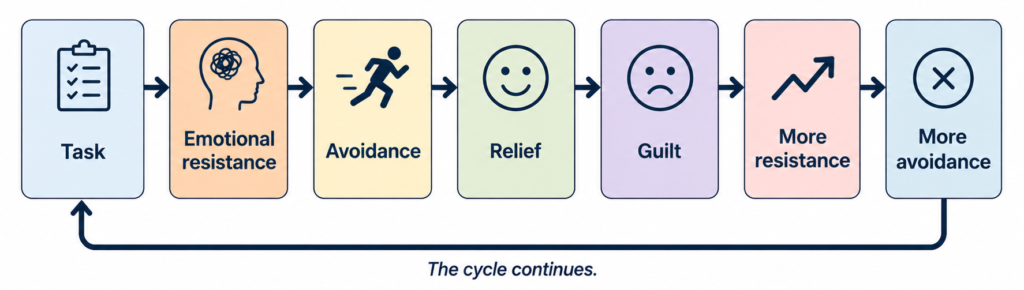
What’s really happening under the surface when procrastination strikes is an Avoidance Loop:
- A task creates discomfort.
- Avoidance removes discomfort.
- Relief rewards avoidance.
- Avoidance becomes easier to repeat.
This is why procrastination can become so easy: avoidance is immediately rewarded with relief, while the consequences of delaying are usually delayed.
I’ll be the first to admit I think most people could just try a little harder.
But even I recognize just try harder is a toxic positivity cliche.
In many situations, especially when struggling with procrastination, trying harder doesn’t address the mechanism at play.
And the mechanisms keeping you stuck only get worse when an uncomfortable task is also overwhelming.
Why Overwhelming Tasks Make Us Avoid Starting
If there’s one thing the brain hates more than discomfort it might be ambiguity.
Large tasks often contain a lot of missing information, at least in the moment.
The brain naturally doesn’t know where to begin.
Ambiguity feels like knowing and not knowing all at the same time.
Consider the difference between being told to “Write the report” versus “Open the document and outline three headings.”
As complexity in scope or scale increases, so does the perceived effort.
This undefined yet still very much perceived effort creates resistance.
Unlike the big, hairy gorilla of procrastination, overwhelm is often solved by breaking projects or tasks into small enough actions that make the first step clear and easy.
Simply put, clarity reduces friction.
The Perfectionism-Procrastination Connection
Perfectionism is both powerful and destructive.
On one hand, striving for perfection can lead us to accomplishing more than we ever thought possible.
On the other, it is an ever changing and unattainable goal that can lead to despair and depression.
Within the ideal of perfectionism is the fear of not meeting expectations.
That fear (form of discomfort) leads to task resistance.
We naturally do not want to attempt the task if we don’t think we can do it properly, which in this case is perfectly.
It’s OK to not want to produce mediocre work.
It’s not OK to produce no work at all out of fear it will be mediocre at first.
The key word is at first.
Because unlike no work, mediocre work can at least be improved with feedback, editing, and support.
With perfectionism, procrastination manifests itself as “I just need to research a little more and then I’ll start” or “I can’t share this with anyone until I’ve edited it just a little more.”
While high standards are welcome in the world of ambition, paradoxically they can produce less output.
Mitigating perfectionism typically requires separating the standard for starting from the standard for finishing.
Day-to-day this means internally acknowledging that a low-quality first draft leads to a high-quality final draft and recognizing polished products begin as rough concepts.
I’ve struggled with perfectionism-procrastination throughout my professional career and personal life.
At work, sharing a first draft proposal with other team members brings fear of judgement.
Judgement of knowledge, time spent, or experience.
Personally, not knowing how a recipe will turn out can cause me to not want to host a friendly gathering or commit to bringing someone a meal.
I can already hear what you’re saying – don’t worry, it’s the thought that counts.
And I couldn’t agree more!
If only we would be willing to extend the same amount of grace to ourselves that we extend to others.
Why Motivation Doesn’t Solve Procrastination
People struggling with procrastination often say or think they’re just not motivated.
Unfortunately, motivation fluctuates.
If we accept a reality where procrastination can only be solved by motivation, we are agreeing to a life entirely outside of our own control.
The results would be progress, or lack thereof, ebbing and flowing unexpectedly.
It would be a sad reality if we gave emotions control over our actions and only performed tasks when we felt like it.
Motivation can certainly help initiate behavior change but it cannot be the pillar on which productive action rests.
A long history of successful achievements presents the opposite.
Action can generate motivation.
Taking one step facilitates another.
That’s really what The Psychology of Discipline is all about.
Embracing intentional, consistent action regardless of external factors like motivation.
A life of discipline reduces dependence on momentary feelings and instead cultivates a habit of making progress.
That’s why discipline often beats motivation.
Your Environment Is Often Stronger Than Your Intentions
Let’s face it.
We are not as strong as we often believe we are.
- A chirp from our phone pulls us away from just about anything.
- An advertisement leads us to believe we need something.
- Television in the background captures our focus more than what’s in front of us.
- Convenient fast food options make us forget who we were just moments ago at the grocery store.
- Other people’s words and lives force us to second guess our existence.
So easily we blame ourselves for behavior our environment is continuously encouraging.
Much of our environment is outside our control.
But we can reduce the friction for our desired behaviors by creating environmental boundaries.
We can take physical steps to manage our attention which significantly reduces the constant stimulation we face:
- Put your phone in another room and on silent.
- Set time limits for deep work that you can stick to.
- Spend time intentionally alone for focused planning.
- Write down your goals and post it somewhere visible.
- Ask people to help not distract you when necessary.
- Spend more time creating than consuming.
Our environment is designed to capture your attention.
Without an environment designed to support your intentions, your willpower will always be at a disadvantage.
If you want to build a practical system for protecting your attention, the 7-Day Attention Reset walks you through seven days of identifying what deserves your attention and creating boundaries that make it easier to follow through.
Why Your Brain Chooses Immediate Rewards Over Important Work
One reason I love mowing my yard so much is because it provides immediate reward.
I can see the short, manicured grass immediately following my every step.
This short term gratification spurs me on as I look forward to the entire yard looking just as beautiful.
But that’s not how life works.
Important work often pays later while distraction and procrastination pay now.
We see it clearly with exercise, saving money, and studying.
When viewed through the lens of delayed gratification, procrastination makes a lot of sense.
Procrastination pays now and hurts later.
To embrace the reversed hurts now, pays later, we must live intentionally.
Social media is almost perfectly designed to exploit this psychological tendency by delivering immediate novelty with almost no effort.
I wish I could tell you there is a shortcut, but there isn’t.
A disciplined life that accomplishes high-priority tasks is one that expects discomfort now for future reward.
No one can do the hard stuff for us.
And down the road, days or maybe decades, discipline pays big time while procrastination hurts.
Ultimately, we all decide how much comfort we are willing to trade for something we value more. The challenge is recognizing when comfort is helping us recover and when it is quietly keeping us from moving forward.
At one end of the spectrum are people making decisions almost entirely for immediate gratification. At the other are people consistently sacrificing today’s comfort for benefits that may not arrive for years or even generations.
The appropriate place on the spectrum for you is somewhere in-between but the danger leaning too far one way is clear.
Why Guilt Makes Procrastination Worse
Guilt and procrastination are negative feedback loops with each other.
As you procrastinate, you feel more guilty delaying taking action on something you or others have deemed important.
The weight of the guilt increases the emotional toll the task carries.
The heavier the task becomes emotionally, the more likely you are to avoid it.
A key solution here is separating action from identity.
Sure, you procrastinated, but that doesn’t mean you are a procrastinator.
Action does not equal identity.
Instead of letting your emotions merge the two together, focus on restarting the effort rather than punishing yourself.
Yes, you’ve had two weeks to make progress and now you’ve only got one week left before it’s due, but guess what?
The next best time to start is right now.
Self-punishment and dwelling on what wasn’t done will not make things any better.
But taking a small step forward will put a much needed wind in your sails and you might get it all done sooner than expected.
Procrastination vs. Discipline: What’s the Difference?
Procrastination and discipline are polar opposites.
While procrastination prioritizes immediate relief, discipline tolerates temporary discomfort in service of something more valuable.
Procrastination superficially eliminates resistance while discipline actually breaks through it.
Procrastinating people tend to think they simply aren’t disciplined.
They also believe disciplined people don’t feel or experience the same desire they do to avoid tasks.
The reality is much simpler, yet it highlights something negative within a person which is hard for many to accept.
Disciplined people are just people who have chosen to move forward despite the friction.
Discipline does have an easier button, however.
Repeated actions facilitate future action.
What we repeatedly practice, we become.
Repetition doesn’t just make disciplined action easier. Given enough time, it becomes the pathway to mastery. Most people never reach exceptional levels of skill because they stop after becoming merely competent. In Why Most People Never Reach Mastery, I explore why people plateau, how comfort quietly replaces growth, and why years of deliberate practice are required before extraordinary results begin to emerge.
This is why even the smallest of disciplined practices are so powerful.
Waking up to your alarm rather than hitting the snooze doesn’t just affect you in that moment.
It contributes to building a disciplined character that doesn’t run from difficulty.
The same applies to making your bed, doing chores, exercising, and maintaining your nutrition.
All of these daily habits of discomfort add up to a life that leans towards action despite resistance.
Is Procrastination the Same as Executive Dysfunction?
No.
But they overlap.
People with ADHD (attention deficit hyperactive disorder), who can experience some form of executive dysfunction, may relate to procrastination differently than people who do not exhibit ADHD behaviors.
While many of the traits of procrastination are similar and positively affected by steps discussed in this article, executive dysfunction impacts a foundational level of determination.
This is certainly not medical advice, but there are countless articles available on the subject of reducing procrastination for ADHD impacted individuals.
Some noteworthy tactics that are reported as particularly effective include:
- Visual cues
- Gamifying tasks
- Introducing novelty
- Creating personal challenges
- Paring enjoyable activities with boring ones
- External accountability
Ultimately, knowing ourselves and what helps us is most important.
How to Stop Procrastinating When You Know What to Do
How to Stop Procrastinating
The first step is not to eliminate every reason you procrastinate.
It’s to make starting easier than continuing to avoid the task.
Identify the source of resistance, reduce the size of the first action, remove obvious distractions, and commit to beginning before you feel completely ready.
Below are clear, practical steps you can use to stop procrastinating when you know what you need to do:
1. Expect Resistance and Discomfort
Knowing it’s coming keeps you from being surprised. The sooner you recognize the invisible strings of procrastination taking hold, you’ll be able to counter it.
2. Accept Procrastination as an Emotional Behavior
Procrastination is not who you are, it’s how you feel. It’s intangible, like fear, worry, and anxiety. While it’s a very real thing, it’s also something that can be dealt with in healthy ways. Choose to deal with it rather than ignore it and hope for the best.
3. Make the Next Action Obvious
When you feel procrastination taking place, try to identify if it’s coming from a place of overwhelm due to ambiguity or perfectionism. If the task is big and overwhelming, focus entirely on first step. “Work on taxes” could become “find the first tax document”. “Write an article” becomes “create an outline”. “Cultivate friendships” can simply be “send a message to check in”. The smaller and more defined starting becomes, the less friction you’ll face.
4. Commit to Five Minutes
In fitness, it’s a common phenomenon that people struggle to start a 30 minute workout. But anyone can commit to a 5-minute workout. And in those 5 minutes, something magical happens. They go longer than 5 minutes. The same is true for just about every task. Starting is the hardest part, but an object in motion often stays in motion. Don’t fight with a 1-hour walk in the neighborhood. Just take a 5-minute walk and see what happens. Don’t meal prep for the week, meal prep for today. Write one paragraph. Perform one exercise. Make one phone call. Starting is psychologically different from finishing. Accept a very short-term result from minimal action and you’ll be amazed how long-term it becomes.
These four steps provide a practical framework for overcoming procrastination and building momentum.
But if you want to cultivate an environment where you can more easily succeed, here are a few additional tips. These will improve your effectiveness and further reduce the struggle to procrastinate.
Remove the Easiest Escape Routes
Cultivating our environment also requires action, but it’s far less difficult than performing the task.
There are many things that divide our attention and tempt us to procrastinate.
Here are a few simple ideas that feel small but work wonders in designing our environment rather than continually fighting it:
- Place your phone in another room.
- Close unnecessary tabs on browsers.
- Block distracting websites when appropriate.
- Prepare your workspace beforehand.
- Schedule the action.
- Replace “I’ll do it later” with a specific time/context.
- Use calendar or routine cues.
- Protect important work before reactive work consumes the day.
Reduce the Emotional Stakes
The above strategies are mostly physical, tangible things that can be done to cultivate intention action.
But many times the roadblock is emotional.
We are complex creatures and in order to accomplish our highest priority tasks we must learn to embrace the following:
- Imperfect first attempts are allowed.
- Drafts can be created before editing should occur.
- Practice before performance creates opportunities of improvement.
- Small momentum leads to large movement.
- Action reduces resistance.
- Small wins create evidence of capability.
- Continuing is often easier than starting.
Build Systems That Survive Low Motivation
None of us are motivated or inspired all the time.
We need systems that help us keep moving forward even when we don’t feel like it.
These systems are:
- Routines
- Environmental cues
- Default behaviors
- Preparation
Many times when I find myself not completing a regular task or struggling to start, I also notice my daily routine has changed.
Routine drift happens quickly and quietly, with only the smallest of reasons.
Watching a movie late might turn into not waking up early to exercise tomorrow.
Not prepping meals on Sunday might become an unexpected restaurant trip on Monday.
Debugging your daily routine will illuminate areas in your life that are not going according to plan and give you the opportunity to make adjustments.
As your routines develop in healthy ways, you’ll find task resistance goes down.
When Procrastination Is Actually Telling You Something
Procrastination itself isn’t inherently bad or good.
Instead it’s a blinking light on the dashboard of your life that signals an underlying issue.
Procrastination might mean:
- Maybe the task genuinely isn’t important.
- Maybe you’re overcommitted.
- Maybe the goal belongs to someone else.
- Maybe your priorities changed.
- Maybe you’re exhausted and need recovery.
- Maybe the task should be delegated or eliminated.
Intentional living doesn’t mean being maximally efficient at completing everything.
Instead it’s taking each moment with purpose.
Sometimes the correct response to resistance is investigation rather than force.
Not every delay is procrastination. Sometimes an intentional delay is actually a wise decision because the task isn’t important enough to prioritize, circumstances have changed, recovery is needed, or someone else is better suited to handle it.
The difference is whether the delay is deliberate and purposeful or whether you’re avoiding something you genuinely intend to do.
We should examine if a task is truly something we should focus on, now or ever.
With intentionality we can distinguish between chronic avoidance and intelligent reconsideration.
Recently, I was struggling with procrastination at work on a specific task.
I knew the immediate steps necessary but I kept focusing on other similarly important things.
After some feedback from others, and a bit of reflection, I realized my procrastination was a signal that the task should be delegated.
Someone else took the task immediately and moved it forward.
In that situation, the answer wasn’t to stop procrastinating, drop my other tasks, and focus on this task.
The answer was that I wasn’t the right person to get the task started.
It may be hard to accept that truth if you lean towards wanting control.
But letting go in appropriate moments might allow someone else to tackle a task you’re struggling to start.
The Cost of Procrastination Is Bigger Than Lost Time
Our minds often act as a buffer against negative outcomes.
While we procrastinate, our brain likes to tell us we are avoiding immediate discomfort and that’s all it is.
Unfortunately, procrastination affects us in deeper ways.
Missed Opportunities
Sometimes progressing a task grows who we are. The feeling of difficulty might be because the task will stretch us or require us to learn something new. Or it might mean we can’t take on something new until we finish the task at hand. Both options mean we are actually missing out on things that might be good for us.
Mental Load from Unfinished Commitments
Let’s face it. Tasks add up. Even when we try to ignore things, they are still there, resting on our shoulders and using up precious, limited mental space. The cognitive exhaustion accumulates and increases the overall resistance we face to each open task.
Reduced Trust in Yourself
Finding our identity in our performance, though improper, is still very common. As we put more and more things off, we accept it as part of who we are. It contributes to our sense of self and directly affects how well or how quickly we think we can accomplish a new task. In fact, we might consider our past performance and reject new tasks or big tasks immediately, believing we do not have the capacity to perform at a consistently high level.
Goals that Remain Intentions Indefinitely
We make goals for a reason. We believe they are good for us and we want to achieve them. Sadly, procrastination that goes unchecked turns our goals into wishes. I had wanted to learn piano for a long time, yet until I did something about it, the goal remained locked away. I waited. I procrastinated. I made excuses. Until I didn’t. I took one small step and 14 months of practice later the rest is history.
Important Relationships Continually Postponed
Relationships are uniquely different than tasks. A postponed task might remain identical for days or weeks at a time. The task may not change at all. With people, if we’re not growing closer, we may be growing apart. Not making that phone call, sending that message, or meeting up in person can quietly kill a beautiful thing. Even when making time for people is hard, the key to lasting friendships remain consistent: Don’t postpone opportunities to connect.
Years Can Disappear Through Accumulated “Laters”
It’s easy to lose track of time. I often flag emails I need to do something about. It’s incredible how quickly I’ll notice a flagged email is weeks or months old. If we don’t engage a task promptly, we may not engage it for much longer than we realize. If something is important, starting it right away will keep you far away from regret.
The danger isn’t occasionally procrastinating.
It’s repeatedly postponing the things you claim matter most.
A life can become unintentional one postponed decision at a time.
With intentionality, the opposite is also true.
A life can become intentionally rewarding and impactful one timely decision at a time.
From Intention to Action
Knowing what you ought to do certainly matters. But knowing isn’t enough.
Until that first moment of decisive action, we are stuck with intention.
Intention will linger as long as we allow the resistance to strengthen.
Rather than waiting to eliminate resistance after the resistance appears, it’s best to reduce it before it shows up.
The two-pronged strategy to make important behavior easier to begin and avoidance harder to choose is:
- Use systems and adjust your environment.
- Build discipline through repetition
When you feel resistance, question it.
Ask why it’s there and what’s causing the feeling to procrastinate.
Ultimately, intentional living requires translating values into behavior.
And that means embracing short-term difficulty for long-term reward.
If you’re looking for practical ways to put these ideas into action, I’ve collected the books, apps, and tools that have genuinely helped me build discipline, reduce distractions, and live more intentionally on my Resources page.
Final Thoughts
Procrastination isn’t defeated by accumulating more productivity advice.
It’s understanding why you’re avoiding something to gain leverage over it.
You won’t always feel motivated.
I certainly don’t.
You won’t always want to begin.
The goal isn’t perfect productivity.
The goal is reducing the distance between what you say matters and what you actually do.
Your intentions describe the life you want. Your repeated actions create the life you get.
Every meaningful life is built one decision at a time. Each moment you choose action over avoidance, you narrow the gap between the person you intend to become and the person you are becoming.
