There is a particular kind of procrastination that is harder to explain than simply putting off something you don’t want to do.
You put off the thing you actually care about.
You want to write the book, but you don’t write.
You want to get healthier, but you keep finding reasons to start next week.
You want to have the conversation, but you never quite find the right moment.
You want to change careers, build something, learn a skill, repair a relationship, or pursue a goal you’ve carried around for years.
And somehow, the things you say matter most keep getting pushed further into the future.
That can be confusing.
If you don’t care, avoidance makes sense.
But what happens when you do care?
Why would we repeatedly avoid the very things we claim to value?
The answer isn’t always laziness.
Sometimes it isn’t even a lack of discipline.
We often avoid important things because important things carry emotional weight.
They can expose us to uncertainty, failure, judgment, responsibility, disappointment, or the possibility that reality won’t match what we imagined.
The more something matters, the more it can have the power to make us uncomfortable.
The more uncomfortable a task makes us, the harder it can be to move forward.
Unfortunately, sometimes avoiding that discomfort feels easier than discovering what happens if we actually try.
Why Do We Avoid Things That Matter to Us?
The simplest explanation is that importance and emotional difficulty often rise together.
A meaningless task can be easy to start.
If you make a mistake, who cares?
Nobody is watching.
Nobody might care if you start or stop.
Your identity isn’t attached to the outcome.
There really isn’t much to lose.
But consider something that matters deeply.
A book you’ve wanted to write for ten years.
A business you’ve thought about starting.
A relationship you desperately want to repair.
A career change you’ve been imagining.
A fitness goal you’ve failed to reach before.
Now the stakes feel different.
You aren’t simply completing a task.
You’re confronting a question:
What if I try and fail?
Or perhaps:
What if I try and discover I wasn’t as capable as I thought?
Or even:
What if I succeed and everything changes?
Suddenly, avoidance has a purpose.
It protects you from having to find out.
Personally, the what if feels a lot better than reality.
I recently joined the two-plate club, which is fitness jargon for benching 225 pounds.
It’s easy to think “Yeah, I can probably lift that.”
But trying to actually lift that goes one of two ways.
You succeed and celebrate.
Or you fail and have to wrestle with why.
Avoidance Is Often About Emotion, Not Effort
This is one of the most useful ways to understand procrastination.
We often assume people avoid difficult tasks because they don’t want to do the work.
Sometimes that’s true.
But often, the work itself isn’t the entire problem.
It’s what the work represents.
A blank page can represent judgment.
A difficult conversation can represent rejection.
A job application can represent uncertainty.
A workout can represent confronting how far you’ve fallen from where you wanted to be…or where you used to be.
Opening your bank account can represent facing a financial reality you’ve been avoiding.
Starting a business can represent risking your comfortable identity.
The task becomes emotionally loaded.
So you avoid the task and experience temporary relief.
That relief is powerful.
It teaches your brain that avoiding this feels better right now.
And once avoidance produces relief, repeating it becomes easier.
The Avoidance Loop
The pattern often looks like this:
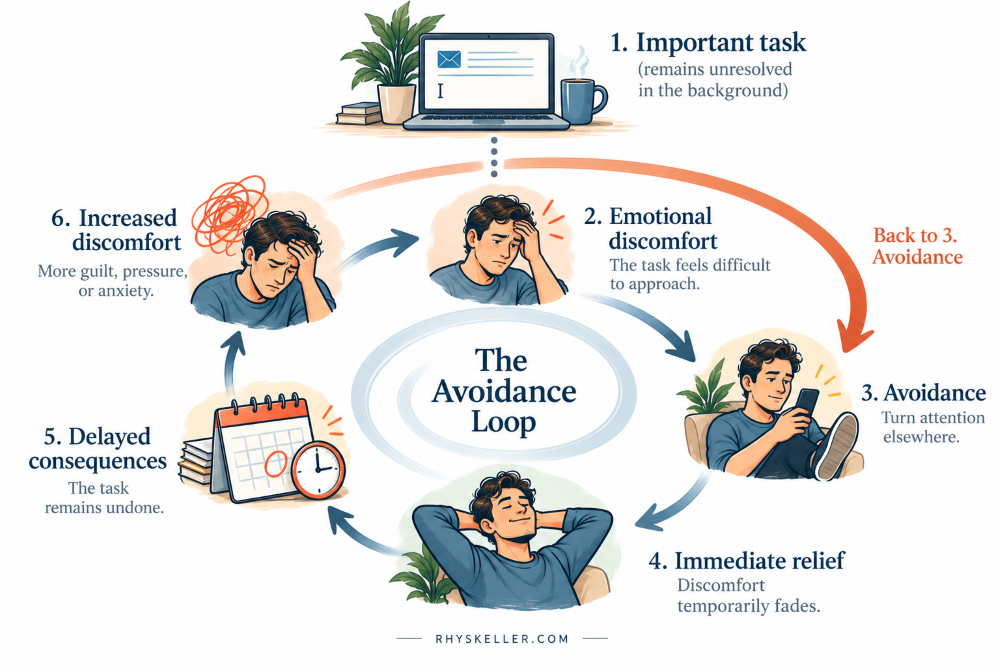
Imagine you need to write an important email.
You think about it.
You feel uncomfortable.
You decide to check something else first.
The discomfort disappears temporarily.
That feels good.
Later, you remember the email.
Now there’s additional guilt because you still haven’t sent it.
The task feels even heavier.
So you avoid it again.
The cycle strengthens.
This is closely related to the psychology of procrastination I’ve explored in Why You Procrastinate Even When You Know What to Do (and How to Stop).
Procrastination isn’t always evidence that you don’t care.
Sometimes it’s evidence that you care so much that the task has become emotionally difficult to approach.
And you’re hoping to tackle it when the timing is right, when it feels easier, or when someone else gets it started for you.
But we all know things don’t usually become easier with time.
The More Important the Goal, the More We Can Fear Failure
Failure on an insignificant task is easy to tolerate.
Failure on something you’ve dreamed about for years is different.
If you don’t care about becoming a painter, a bad painting doesn’t mean much.
If you’ve dreamed of becoming an artist since childhood, producing mediocre work can feel like evidence against your identity.
You wonder why you can’t get it right.
You wonder why you ever thought you could do it in the first place.
You wonder what else might be impossible for you.
That’s a much heavier burden.
This is why important goals can paradoxically produce more avoidance.
The goal matters but your expectations rise.
The possibility of failure becomes painful and starting becomes harder.
Eventually, not starting provides a strange form of protection.
As long as the book remains unwritten, you can still imagine that you might write an excellent book someday.
It would have been the best, no doubt about it!
As long as the business remains an idea, it can still be a successful business.
As long as you haven’t applied for the job, you haven’t been rejected.
As long as you haven’t tried, the dream remains intact.
Potential is comfortable. Reality is measurable.
And measurable things can be very, very disappointing.
Sometimes We Prefer the Fantasy Over Reality
There is something psychologically appealing about an unrealized goal.
An unrealized goal can be perfect.
You can imagine yourself becoming healthier without confronting the monotony of exercise.
You can imagine writing a book without wrestling with a bad first draft.
You can imagine becoming financially independent without changing your spending habits.
You can imagine starting a business without dealing with customers.
You can imagine learning an instrument without practicing scales.
The fantasy contains the reward without the friction.
Reality requires both.
This is why action is so revealing.
The moment you begin, your imagined future encounters the real world.
The results may be better than expected.
They may be worse.
Either way, you learn something.
We Sometimes Avoid Things Because We Don’t Know Where to Start
Not every form of avoidance is rooted in fear.
Sometimes the problem is ambiguity.
A goal can sound inspiring while still being completely unusable as an instruction.
“Get healthier.”
“Write a book.”
“Start a business.”
“Fix my finances.”
“Learn to play piano.”
“Improve my marriage.”
These are destinations.
They aren’t necessarily first steps.
When the brain can’t identify a clear next action, a large goal can feel enormous.
And enormous things are easy to postpone.
“Write a book” is far more difficult to accomplish than “Open a document and write the first 300 words”.
A clear next action has boundaries.
You know what success looks like for the next few minutes.
That reduction in ambiguity can dramatically change the emotional experience of starting.
Clarity reduces friction.
We Avoid What Threatens Our Identity
Some goals challenge how we see ourselves.
Suppose you’ve spent twenty years thinking of yourself as someone who is practical.
Now you want to pursue something creative.
That creates tension.
Or you’ve always considered yourself intelligent, and now you’re learning something that makes you feel terrible.
Or you’ve built a career around being competent, and you’re considering becoming a beginner in an entirely different field.
Or you’ve always been independent, and now you need to ask others for help.
The goal itself isn’t necessarily the problem.
The identity conflict is.
You have to become comfortable with a version of yourself that doesn’t fit the old story.
That can take time.
And sometimes avoidance is simply the mind protecting an established identity.
I remember when I moved states to take a step up in my career.
I went from being comfortable as second-in-command to being a leader.
Immediately, I was performing tasks I had never done before while also not performing the tasks that I was most proficient in.
It made me question my decisions and I still deal with imposter syndrome despite a long track record of success.
We Can Become Attached to Being “The Person Who Is Going to…”
There is another subtle trap.
Sometimes we receive psychological satisfaction from identifying with a future version of ourselves.
“I’m going to start writing.”
“I’m going to get in shape.”
“I’m going to start investing.”
“I’m going to learn Spanish.”
“I’m going to start that business.”
“I’m going to clean up my finances.”
Talking about the future can create some of the emotional reward associated with progress without requiring the discomfort of actually making progress.
You get to imagine yourself as the person who will eventually do the thing.
But eventually is not a date.
Eventually can last for years.
At some point, intention has to become behavior.
After signing up for my first Spartan race, I began telling people about it.
Everyone was so encouraging and excited for me to be training for it.
Sometimes, people would ask how my training was going.
It always happened on days (or weeks) that I didn’t feel like I was giving it my best.
The struggle with future identity is so real.
I became “The person who was doing a Spartan race.”
But it was still months away.
Again, the feelings of imposter syndrome crept up.
The healthiest response is putting in the work to help usher that future goal into reality.
The opposite, of course, is treasuring how people perceive our future selves but never becoming that person.
The Cost of Avoiding What Matters
Avoidance feels cheap in the moment.
It isn’t.
The bill just arrives later.
You may lose future opportunities.
You may carry unfinished commitments.
You may spend years wondering what could have been.
You may gradually lose confidence in your ability to follow through.
You may begin to identify as someone who doesn’t finish things.
And perhaps most painfully, you can become accustomed to postponement.
One “later” doesn’t seem significant.
Hundreds of them can become a life pattern.
This is one reason I wrote about The Hidden Cost of Comfort.
Comfort isn’t inherently bad.
But repeatedly choosing immediate relief over meaningful action can quietly shrink what you are willing to pursue.
Avoidance Can Damage Your Trust in Yourself
There is a psychological cost to repeatedly making promises to yourself and breaking them.
You say you’ll start Monday.
Monday arrives.
You don’t.
You say you’ll do it tomorrow.
Tomorrow arrives.
You don’t.
Eventually, the problem becomes larger than the original task.
You begin wondering whether you can trust yourself.
Self-confidence isn’t built entirely through positive thinking.
Some of it comes from accumulated evidence.
You tell yourself you’re going to do something.
Then you do it.
You repeat the process.
Over time, you develop evidence that your intentions can become actions.
The opposite can happen too.
Repeatedly postponing meaningful actions can teach you that your own plans aren’t reliable.
And that is a difficult pattern to reverse.
But it can be reversed.
Action Builds Confidence Differently Than Thinking Does
You can think about changing your life for years without becoming more confident.
Thinking can help.
Planning can help.
Research can help.
Reflection can help.
But eventually, evidence matters.
You take the first step.
You discover you can tolerate the discomfort.
You take another.
You make a mistake.
You recover.
You keep going.
Eventually, your brain has something new to work with.
“I did it” is very different from “I think I could do it.”
Confidence built through action tends to be more durable because it’s attached to experience.
In The Psychology of Discipline: How to Stay Consistent When Motivation Fades, I emphasize repeated behavior rather than waiting for the right emotional state.
Discipline isn’t about never feeling resistance.
It’s about developing a history of moving forward despite it.
Why Motivation Is a Weak Foundation for Important Goals
Motivation feels wonderful.
When you’re motivated, action seems easy.
You make plans.
You feel optimistic.
You imagine the future.
You may even believe you’ve finally changed.
Then Tuesday arrives.
You’re tired.
The excitement is gone.
The work remains.
If your system depends entirely on motivation, progress becomes unpredictable.
This is why discipline matters so, so much!
You don’t need to feel inspired every time.
You need a way to continue when inspiration disappears.
Many people interpret a lack of motivation as evidence that they don’t really want the goal.
That’s not always true.
Sometimes you simply reached the part where motivation stops carrying the load.
Your Environment Can Make Avoidance Easier
Avoidance doesn’t happen in a vacuum.
Your surroundings can encourage it.
If your phone is beside you, distraction is easy.
If your workspace is chaotic, starting may feel harder.
If your calendar is packed, important work gets pushed aside.
If your television is always on, passive entertainment becomes the default.
If your goals aren’t visible anywhere, they disappear from your immediate awareness.
Why Your Environment Shapes Your Behavior More Than Willpower shows the solution to avoidance isn’t simply trying harder.
It’s making the desired behavior easier to begin and the escape route slightly harder to access.
Friction Can Be the Real Problem
Consider two versions of the same task.
Version one
You need to write.
You open your laptop.
Your browser has twenty tabs.
Your phone is beside you.
Your document isn’t open.
You don’t know exactly what section you’re working on.
You start checking email instead.
Version two
You need to write.
Your document is already open.
You’ve written tomorrow’s first sentence at the end of today’s work.
Your phone is in another room.
You know the next section.
You sit down and begin.
Same person.
Same goal.
Very different amounts of friction.
This is why behavior change isn’t always about becoming more disciplined.
Sometimes it is about removing unnecessary obstacles between intention and action.
The First Step Is Psychologically Different From the Rest
Starting a task often feels harder than continuing it.
Once you’re moving, momentum can take over.
This is why “work on my project” can feel overwhelming while “open the document” feels almost trivial.
The first action crosses a psychological threshold.
Before you start, the task exists in your imagination.
After you start, you’re dealing with something concrete.
That shift matters.
So when you’re stuck, don’t ask:
“How am I going to finish this?”
Ask:
“What is the smallest meaningful action that would count as starting?”
And your answer might be:
- Open the document.
- Put on your shoes.
- Write one paragraph.
- Make the phone call.
- Transfer the first $50.
- Read five pages.
- Send the message.
- Schedule the appointment.
- Spend ten minutes cleaning the problem area.
The objective isn’t to trick yourself.
It’s to lower the barrier to entry.
You May Be Avoiding a Decision, Not a Task
Sometimes what looks like procrastination is actually indecision.
You keep postponing the project because you haven’t decided what you actually want.
You keep avoiding the conversation because you haven’t decided what you’re willing to say.
You keep delaying the career change because you’re unsure whether you actually want to leave.
You keep researching because choosing one direction would eliminate other possibilities.
In those situations, doing more work may not solve the problem.
You need clarity.
That can be uncomfortable because making a decision closes doors.
But refusing to decide doesn’t preserve infinite freedom.
It simply creates a different kind of commitment: commitment to the status quo.
Sometimes Avoidance Is Giving You Useful Information
Not every avoided task deserves to be attacked with more discipline.
Sometimes resistance contains information.
Maybe you’re avoiding a task because someone else should be doing it.
Maybe the goal no longer matters.
Maybe the project conflicts with your priorities.
Maybe the timing is wrong.
Maybe you agreed to something you shouldn’t have agreed to.
Maybe you’re exhausted.
Maybe you need help.
This is why intentionality matters.
Before forcing yourself through resistance, consider if this is something you should actually be doing.
That one question can save enormous amounts of effort.
Discipline isn’t blindly doing everything you previously decided to do.
It’s also having the judgment to reconsider commitments that no longer make sense.
The Difference Between Avoidance and Rest
Rest is not procrastination.
This distinction matters because productivity culture can make people feel guilty for stopping.
If you’re physically or mentally depleted, rest may be exactly what you need.
The problem is not taking a break.
The problem is using “rest” to avoid something important indefinitely.
“Will this break restore my capacity, or simply help me avoid the thing I don’t want to face?”
It’s OK if sometimes the answer is rest.
It’s not OK if the answer is avoidance.
Learning to distinguish between them is part of what I call sustainable performance.
Sustainable Performance: How to Stay Productive Without Burning Out explores this broader relationship between output, recovery, energy, and long-term consistency.
Most people want to perform at a high level long term.
You don’t need to maximize effort.
You need to make meaningful progress without destroying your capacity to continue.
Why Important Goals Need Smaller Commitments
A large goal can remain abstract for years.
A small commitment creates evidence.
Instead of saying:
“I’m going to write a book.”
Say:
“I’m going to write for twenty minutes on Tuesday.”
Instead of:
“I’m going to get in shape.”
Say:
“I’m going to train three times this week.”
Instead of:
“I’m going to fix my finances.”
Say:
“I’m going to review my spending tonight.”
Instead of:
“I’m going to become a better reader.”
Say:
“I’m going to read ten pages before bed.”
The smaller commitment isn’t less serious.
It’s more actionable.
You can build something enormous out of repeated actions that initially look almost insignificant.
When I doubt this, all I have to do is look at my Roth IRA.
It started over 17 years ago with $25 invested per month.
It felt like peanuts.
No, less than that.
It felt insignificant.
But it grew, slowly but surely, and the magic of compound interest, along with additional investments when I could actually afford it, paid off.
Small commitments facilitate action.
And action facilitates results.
Delayed Gratification Makes Avoidance Harder to Justify
One reason we avoid meaningful work is that the reward is usually distant.
The task asks something from you now.
The benefit arrives later.
That imbalance makes distraction attractive.
You experience the discomfort immediately while the reward remains abstract.
This is exactly why The Psychology of Delayed Gratification might resonate with you.
Learning to value future outcomes changes the calculation.
That doesn’t mean rejecting every present pleasure.
It means giving your future self a voice in today’s decisions.
Attention Makes Avoidance Easier Too
You can only avoid something if something else is available to occupy your attention.
And modern life gives us an almost unlimited supply.
A difficult task sits in front of you.
You don’t want to start.
Your phone is right there.
The internet is open.
There is always another article.
Another video.
Another message.
Another task.
Another notification.
Another thing you could research.
This is why attention management and avoidance are deeply connected.
If distractions are always available, avoidance can feel productive.
You’re doing something.
You’re just not doing the thing that matters.
How to Think Clearly When Everything Is Competing for Your Attention explores this larger problem of deciding what deserves your attention when everything is competing for it.
Sometimes protecting your attention is simply another way of protecting your priorities.
The Hidden Comfort of Staying Stuck
There is a strange psychological feeling of safety in not changing.
If you don’t act, you don’t have to discover what happens.
You don’t have to risk failure.
You don’t have to disappoint anyone.
You don’t have to become someone different.
You don’t have to explain yourself.
You can maintain the current situation.
That can feel safe.
But there is a cost.
The status quo becomes increasingly familiar.
And familiar can start to feel like correct.
It isn’t.
Something can be familiar and still be wrong for you.
Something can be uncomfortable and still be exactly what you need.
This is one of the tensions behind Why Growth Requires Periodic Reinvention.
Growth sometimes requires recognizing that the system that once served you no longer fits where you’re going.
We Often Wait for Permission We Don’t Need
Maybe you’re waiting until you’re more knowledgeable.
More confident.
More experienced.
More financially secure.
More organized.
More rested.
More certain.
Some preparation is wise.
But there is a point where preparation becomes another form of postponement.
You don’t need permission to begin learning.
You don’t need permission to write a bad first draft.
You don’t need permission to exercise.
You don’t need permission to start a small experiment.
You don’t need to know exactly where the path ends before taking the first step.
Sometimes clarity is produced by action rather than preceding it.
The Question That Can Break the Cycle
When you catch yourself avoiding something important, try asking:
“What am I trying not to feel?”
The answer might be:
- Fear
- Boredom
- Embarrassment
- Confusion
- Uncertainty
- Inadequacy
- Resentment
- Overwhelm
- Disappointment
Once you identify the feeling, the problem becomes more specific.
And specific problems are easier to solve.
If you’re overwhelmed, make the first step smaller.
If you’re distracted, change the environment.
If you’re uncertain, gather enough information to make the next decision.
If you’re afraid of judgment, decide whose judgment actually matters.
If you’re exhausted, recover.
If you no longer care about the goal, reconsider it.
If you’re afraid of failure, accept that trying creates a possibility of failure but refusing to try creates a certainty of remaining where you are.
When my son first joined cross-country in middle school, competing at a meet was a big hurdle for him.
My wife and I kept trying to understand what his roadblock was.
Eventually he said, “If I won’t be in the top 7 and get scored, why bother going at all?”
His resistance to competing may have included every answer on the above list.
And as his parents, my wife and I could see just how limiting a belief he had.
But it’s not just kids who struggle with this stuff.
It’s us adults who either don’t care enough to determine our true intentions or are too afraid to open up an old wound.
Naturally, freedom comes when we are willing to do the work on ourselves, determine the root problem, and be intentional about overcoming it.
A Practical Five-Step Way to Stop Avoiding What Matters
1. Name the thing
Don’t use vague language.
Write down exactly what you’ve been avoiding.
Not “my finances.”
Write:
“I need to review my monthly spending.”
Not “my health.”
Write:
“I need to schedule my first workout.”
Clarity reduces ambiguity.
2. Identify the resistance
Ask what makes the task uncomfortable.
Don’t judge the answer.
Just identify it.
3. Shrink the starting point
Find the smallest action that creates forward movement.
Not the smallest action that lets you pretend you’re working.
The smallest action that actually counts.
4. Change the environment
Remove one escape route.
Make the desired action easier.
Put the tools in place before you need them.
5. Repeat before evaluating
Don’t decide whether the entire goal is worthwhile after one uncomfortable attempt.
Give yourself enough repetitions to distinguish temporary resistance from a genuinely bad direction.
What Happens When You Finally Start?
Usually, nothing magical happens.
You simply discover that the task is real.
Maybe it’s harder than expected.
Maybe it’s easier.
Maybe you enjoy it.
Maybe you don’t.
Maybe you’re good at it.
Maybe you’re terrible.
Maybe you discover that the goal needs to change.
All of those outcomes are useful.
Because now you’re dealing with reality instead of imagination.
Action produces information.
And information makes better decisions possible.
I once created a business to provide entrepreneurs with strategic business advice.
I love business strategy and helping ambitious people so it felt like a no-brainer.
I created a website, a blog (of course), social media handles, and legal documents.
I had my first client and took it very seriously.
And in about 1 week I realized I hated it.
The business, not the client!
I learned valuable things about myself such as not wanting to manage multiple social media platforms for different entities.
Or that I didn’t want to limit my writing to only business strategy topics.
It felt restrictive and turned a passion into a chore.
I started and closed that business in a single year.
But I don’t regret trying it! Taking action helped move me from “What if…” to “What’s next?”
You Don’t Have to Feel Ready
This may be the most important lesson.
Readiness is often treated as a feeling.
It isn’t always.
You can be nervous and ready.
You can be uncertain and ready.
You can be inexperienced and ready.
You can be afraid and still ready to take the next step.
A long time ago I worked with a venture capitalist on a business idea I had.
I was nervous to share it because it was sooo good.
So good I thought someone would steal it.
The venture capitalist had me work the idea through an analysis platform that helped me put real, reasonable metrics to potential outcomes.
I didn’t even need to hear his review of the analysis.
It was obviously.
And it was bad.
If I kept mulling the idea over in my head, I would have lost so much more time and energy wishing and hoping.
But I really was ready to evaluate it.
And that evaluation helped me move on to bigger and better things.
Waiting until discomfort disappears can mean waiting forever.
The goal isn’t to eliminate resistance before acting.
It is to become capable of acting while resistance is still present.
That is discipline.
Your Life Is Built Out of What You Repeatedly Do
A meaningful life doesn’t usually change because of one enormous decision.
It changes through accumulation.
One workout.
One conversation.
One page.
One practice session.
One saved dollar.
One difficult decision.
One hour spent on something meaningful instead of something easy.
One moment when you choose to begin instead of postpone.
Then another.
And another.
Eventually, those decisions become patterns.
Patterns become habits.
Habits influence identity.
Identity influences what you believe you’re capable of doing.
This is why the smallest meaningful actions deserve more respect than they often receive.
They are evidence.
Final Thoughts: Stop Postponing the Things You Say Matter
We all avoid things.
Sometimes we avoid things because we’re tired.
Sometimes because we’re uncertain.
Sometimes because the task is genuinely unimportant.
Sometimes because someone else should be doing it.
And sometimes because we care deeply and don’t want to experience the discomfort that comes with finding out what happens when we try.
That last category deserves particular attention.
Because if you repeatedly postpone the things you say matter most, eventually the postponement becomes part of your life.
The goal remains.
The intention remains.
The reasons remain.
But the years move.
At some point, “later” becomes a very expensive word.
The answer isn’t to become relentlessly productive.
It isn’t to attack yourself every time you hesitate.
It isn’t to force yourself through every uncomfortable feeling.
It’s to become more honest about what you’re avoiding and why.
Then make the next step smaller.
- Reduce the friction.
- Protect your attention.
- Change the environment when necessary.
- Accept that meaningful things can feel uncomfortable.
- And begin.
You don’t need to finish today.
You don’t even need to know exactly how the story ends.
You just need to stop asking your future self to do everything your present self keeps postponing.
Because the things that matter most rarely become easier by waiting for the perfect moment.
Sometimes the most important thing you can do is simply begin.
