You can have the best intentions in the world and still struggle to change your behavior.
You decide to exercise every morning, but keep sleeping through your alarm. You promise yourself you’ll stop checking your phone while working, yet reach for it twenty minutes later. You want to spend less money, eat better, or build something meaningful, but keep falling into the same patterns.
It’s tempting to conclude that you simply need more discipline.
Sometimes, that’s part of the problem. But often, the bigger issue is the environment in which you’re trying to change.
The phone beside you makes distraction easy. The cookies on the counter make snacking convenient. A packed schedule leaves little room for exercise, reading, or focused work. The people around you can reinforce habits you’re trying to break, or help you build better ones.
Your surroundings are constantly influencing your choices, often before you consciously decide what to do.
That’s why lasting behavior change isn’t just about strengthening your willpower. It’s also about designing an environment that makes the behaviors you want easier and the behaviors you want to avoid harder.
Why Willpower Gets Too Much Credit
We tend to tell stories about behavior as though every decision happens in isolation.
Someone eats the dessert because they lack discipline.
Someone checks social media because they lack focus.
Someone procrastinates because they’re lazy.
Someone spends too much money because they lack self-control.
Someone fails to exercise because they aren’t motivated enough.
There is some truth in these explanations.
But not the whole truth.
Human behavior is contextual.
We respond to cues.
We respond to convenience.
We respond to friction.
We respond to social expectations.
We respond to what is immediately available.
We respond to fatigue and stress.
And we respond to patterns that we’ve repeated so many times that they no longer require much conscious thought.
That is why The Psychology of Discipline: How to Stay Consistent When Motivation Fades argues that discipline isn’t simply a test of motivation or willpower.
If your environment continually pushes you toward the behavior you’re trying to avoid, you’re fighting an unnecessary battle.
You may win occasionally.
But eventually, you’re going to get tired.
And when you get tired, what do you think will happen?
Exactly.
How to Design Your Environment for Better Habits?
You can change your behavior by changing the conditions around it.
Designing your environment simply means shaping your surroundings so the behaviors you want become easier to start and the behaviors you want to avoid become harder to repeat.
Your physical space, digital surroundings, routines, schedule, and social environment can all influence the choices you make.
Your Environment Is Always Teaching You Something
Your surroundings aren’t neutral.
They communicate what is normal.
A kitchen full of processed food communicates something different from a kitchen where healthy meals are easy to prepare.
A desk covered with distractions creates a different experience from a desk reserved for focused work.
A phone that constantly vibrates communicates that every interruption deserves your attention.
A home filled with books makes reading more visible than a home where books are buried in a closet.
A calendar packed from morning to night communicates that there is no room for recovery.
Your environment constantly provides suggestions.
Most of them aren’t verbal.
They’re cues.
And repeated cues can become behaviors.
This is one reason changing a habit can be much easier when you change the circumstances surrounding it.
It’s not that changing a habit makes us a stronger person.
We’re just removing some of the forces working against us.
Behavior Often Follows the Path of Least Resistance
People naturally conserve effort.
That doesn’t make us lazy.
It makes us human.
If two choices provide roughly similar rewards and one requires significantly less effort, the easier option becomes attractive.
Consider your phone.
If it’s sitting on your desk, unlocked, and buzzing every few minutes, checking it requires almost no effort.
If you leave it in another room, checking it requires standing up and walking over there.
That tiny inconvenience changes the decision.
The temptation hasn’t disappeared.
You’ve simply introduced friction in a good way.
This principle works in both directions.
If you want to exercise in the morning, putting your workout clothes beside your bed makes the desired behavior easier.
If you want to read before bed, leaving your book on your pillow makes reading more convenient.
If you want to save money, automating the transfer before the money reaches your checking account reduces the opportunity to spend it.
If you want to write, having your document open and ready removes one more barrier between you and the first sentence.
Small changes matter because behavior is influenced by surprisingly small amounts of friction.
For me, even something as seemingly insignificant as having a straw helps me drink more water daily.
What Is Behavioral Friction?
Behavioral friction is anything that makes an action harder to start or complete.
Sometimes friction is physical.
Sometimes it’s mental.
Sometimes it’s emotional.
Imagine that you want to go for a run.
Your shoes are by the door.
Your clothes are already laid out.
You know exactly where you’re going.
The weather is reasonable.
There are very few decisions left to make.
Now imagine the opposite.
You need to find your shoes, or even worse, they’re still wet from a rainy soccer practice!
Your favorite athletic clothes are still in the washing machine.
You haven’t decided where to run.
You need to check the weather.
You aren’t sure how long you’ll go.
You haven’t planned your route.
The physical exercise hasn’t changed.
The friction has.
Many people respond to friction by demanding more motivation from themselves.
A far better and easier response is to remove friction.
Make Good Behaviors Easier
One of the simplest ways to change your behavior is to make the desired behavior easier to perform.
Want to drink more water?
Keep water within reach.
Or at least have a straw handy.
Want to read more?
Keep a book where you normally sit.
Want to exercise?
Prepare your equipment ahead of time.
Want to write?
Keep your writing environment ready.
Want to eat better?
Make healthy food convenient and prepare the food ahead of time.
Want to spend less time on your phone?
Don’t keep it beside you during focused work.
And consider deleting your most distracting apps, at least temporarily.
These aren’t revolutionary ideas.
That’s part of their usefulness.
Behavior change doesn’t always require an elaborate system.
It often just requires making a tweak.
Make Bad Behaviors Harder
The reverse is equally useful.
If something consistently interferes with your goals, increase the amount of effort required to access it.
Delete the distracting app.
Log out of the website.
Move the television remote.
Keep tempting food somewhere inconvenient or out of sight.
Put your phone in another room.
Remove unnecessary notifications.
Don’t save your credit card information on every shopping website.
None of these actions demonstrates extraordinary self-control.
They demonstrate something more practical.
You anticipated your future behavior and designed around it.
That’s a different way of thinking about discipline.
Instead of asking:
“How can I become strong enough to resist this every time?”
we ask:
“How can I make this less available in the first place?”
Willpower Is Still Useful, But It Shouldn’t Do Everything
There is nothing wrong with willpower.
There will always be moments when you need it.
You can’t redesign every part of your life.
Unexpected situations happen.
Travel disrupts routines.
Stress arrives.
Children get sick.
Deadlines appear.
Plans change.
Sometimes you simply have to make the difficult choice.
But there is a difference between using willpower when necessary and building an entire lifestyle that requires constant resistance.
The first is sustainable.
The second is exhausting.
Imagine trying to maintain a healthy diet while keeping your kitchen stocked with foods you are constantly trying not to eat.
Or trying to write while working beside your television.
Or trying to protect your attention while allowing every application on your computer to send notifications.
Or trying to save money while constantly surrounding yourself with advertisements for things you want.
You can succeed.
But why make the job harder?
Your Digital Environment Is Still an Environment
When people hear the word environment, they often imagine physical surroundings.
But your digital environment may influence your behavior just as much.
Your phone is an environment.
Your browser is an environment.
Your inbox is an environment.
Your social media feeds are environments.
Your notifications are environmental cues.
The apps on your home screen are invitations to behavior.
And unlike your physical surroundings, your digital environment can follow you almost everywhere.
You can carry hundreds of distractions in your pocket.
That creates a unique challenge.
Your phone doesn’t simply contain information.
It competes for your attention.
This is why The Ultimate Guide to Attention Management in the Digital Age is such an important companion to this idea. Protecting attention isn’t simply about trying harder to concentrate. It involves deliberately controlling the environments in which your attention is being requested.
Notifications Change the Decision Before You Make It
A notification seems harmless.
One vibration.
One banner.
One sound.
One red number.
But the notification changes your environment.
Before it appeared, you were making one decision:
Continue working.
After it appears, you have another:
Continue working or see what happened.
The interruption creates a new branch in your decision tree.
And if enough interruptions arrive throughout the day, your attention becomes fragmented.
This is one reason How Context Switching Destroys Focus and Productivity fits naturally into the environment discussion.
The problem isn’t simply that you’re distracted.
It’s that your environment keeps presenting new opportunities to abandon the thing you’re doing.
Eventually, maintaining focus becomes an act of repeated resistance.
There is a very real cost to context switching, which is why I created the Context Switching Cost Calculator, a free tool to see just how expensive your distractions are.
The People Around You Are Part of Your Environment
Environment isn’t just physical space and technology.
People matter too.
The people around you influence what feels normal.
If everyone around you exercises, exercise may feel ordinary.
If everyone complains about work, complaining may feel ordinary.
If your friends constantly spend money on expensive experiences, your own spending habits may gradually shift.
If the people around you read, learn, build, and create, those behaviors can become more visible and accessible.
This doesn’t mean you need to abandon everyone who behaves differently from you.
That’s neither realistic nor healthy.
People aren’t environmental variables to optimize.
Relationships have far more depth than that.
But the social environment still matters.
We absorb expectations from the people we spend time with.
Sometimes the most important thing we can do is become surrounded by the right people.
I recently became friends with some very ambitious people and I can tell you from experience that their ambition has put wind in my own sails.
Not every friend needs to be a peak performer, but we should be intentional about who we have given influence in our life and how much influence they have.
Your Schedule Is an Environment Too
Time itself can create behavioral pressure.
Consider two people with identical goals.
Both want to exercise.
Both want to read.
Both want to work on a meaningful project.
Both have the same number of hours in a week.
But one person has protected time for those activities.
The other tries to squeeze them into whatever remains after everything else has happened.
The second person may believe they have a motivation problem.
They may actually have a scheduling problem.
A goal without a place in your life is easy to postpone.
This is why How to Make Time for Your Goals When Life Feels Busy connects so closely with environmental design.
If something matters, it needs somewhere to live in your schedule.
Otherwise, everything else gets first claim on your time.
Why Stress Changes Your Environment Without You Realizing It
Stress makes environmental design even more important.
When you’re rested, you can tolerate more friction.
You can think through a difficult decision.
You can resist an impulse.
You can recover from an interruption.
When you’re exhausted, those things become harder.
This is one reason habits can deteriorate during stressful periods.
The problem isn’t necessarily that your values changed.
Your capacity changed.
Suddenly the easiest option becomes much more attractive.
You order the food instead of cooking.
You scroll instead of reading.
You skip the workout.
You postpone the project.
You stay up late because entertainment feels like the only enjoyable part of the day.
Then the consequences accumulate.
This is one reason Sustainable Performance: How to Stay Productive Without Burning Out emphasizes the relationship between performance, energy, recovery, and sustainable habits.
A system that only works when you’re well-rested isn’t a very resilient system.
Stress Can Create a Cycle of Bad Decisions
The sequence can look something like this:
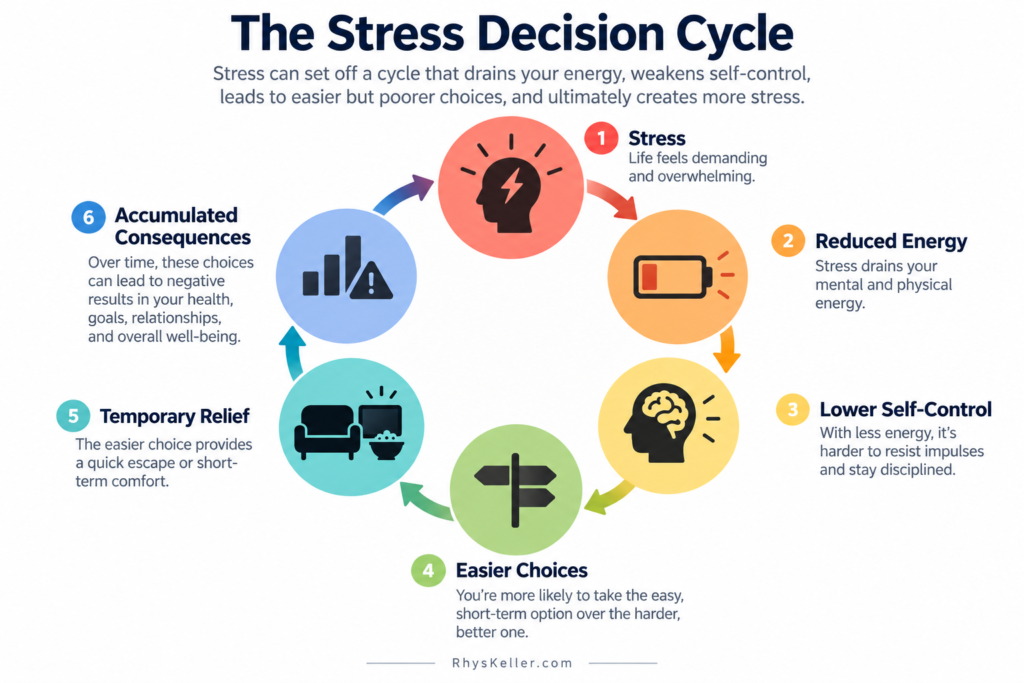
This is not inevitable.
But it is common.
And once you recognize the pattern, you can intervene earlier.
You might simplify your schedule.
You might prepare meals ahead of time.
You might remove unnecessary notifications.
You might protect sleep.
You might create a simpler morning routine.
You might reduce the number of decisions you have to make.
The objective isn’t to engineer a perfect life, though I won’t judge you if you try!
It’s to prevent predictable stress from repeatedly pushing you toward behaviors you don’t actually want.
I experience this often in corporate America.
When work demands are low or stable, my routines are healthy and consistent.
But as work begins taking over due to impending deadlines or missed expectations, I either can’t or don’t put the same level of intentionality into prioritizing healthy food choices, exercise, or sleep habits.
Stress is real and it may appear differently to everyone.
For me, it causes me to focus more singularly on the most critical task, dropping most others.
For other people, it might increase the tendency to procrastinate and avoid the most critical task.
How we handle stress isn’t really the issue though.
It’s becoming more aware that stress affects our environment so we can recognize what must be protected.
Your Environment Can Create Automaticity
Yes, automaticity is a word.
Automaticity is defined by Dictionary.com as the quality or fact of being performed involuntarily or unconsciously, as a reflex, innate process, or ingrained habit.
The most powerful environments make desirable behaviors almost automatic.
Think about brushing your teeth.
You don’t wake up every morning and have a philosophical debate about whether brushing is worth the effort.
The behavior is attached to a routine.
The cue appears.
You respond.
This is what we’re trying to create with other habits.
The goal is not to make every good behavior feel exciting.
The goal is to make it familiar.
Make it expected.
Make it easy.
And ultimately make the right choice our default choice.
Over time, the number of decisions required decreases.
That’s important because decision-making itself consumes mental energy.
The more behaviors you can anchor to stable routines, the less frequently you have to negotiate with yourself.
And let’s be honest. We can be very weak negotiators!
Why Changing Your Environment Can Feel So Uncomfortable
If environmental design works so well, why don’t people change their environments more often?
Because our environments are connected to our identities.
Your desk isn’t just a desk.
It may represent your career.
Your phone isn’t just a phone.
It may connect you to friends, work, entertainment, and information.
Your neighborhood isn’t just a location.
It may represent your history and relationships.
Changing them can feel strangely disruptive even when you know the change would help. Sometimes familiarity itself can become a barrier to growth.
This is one reason Why Growth Requires Periodic Reinvention matters.
Growth doesn’t always mean adding another habit.
Sometimes you have to recognize that the system surrounding you no longer matches the person you’re trying to become.
Don’t Try to Change Everything at Once
One of the easiest mistakes is overcorrecting.
You decide you’re going to completely transform your life.
New diet.
New workout.
New morning routine.
New productivity system.
No social media.
No television.
Two hours of reading.
Three hours of focused work.
Early bedtime.
Meditation.
Journaling.
Cold showers.
And somehow you’re supposed to maintain all of it starting Monday.
Or as your New Year’s resolution!
This is usually unnecessary.
The environment doesn’t need to become perfect.
It needs to become more supportive.
It needs to become easier to make good choices.
Start with the biggest source of friction.
If your phone destroys your focus, deal with the phone.
If your mornings are chaotic, fix the morning.
If your workspace constantly distracts you, change the workspace.
If your schedule has no room for meaningful work, create some room.
One meaningful environmental change can be more valuable than ten new intentions.
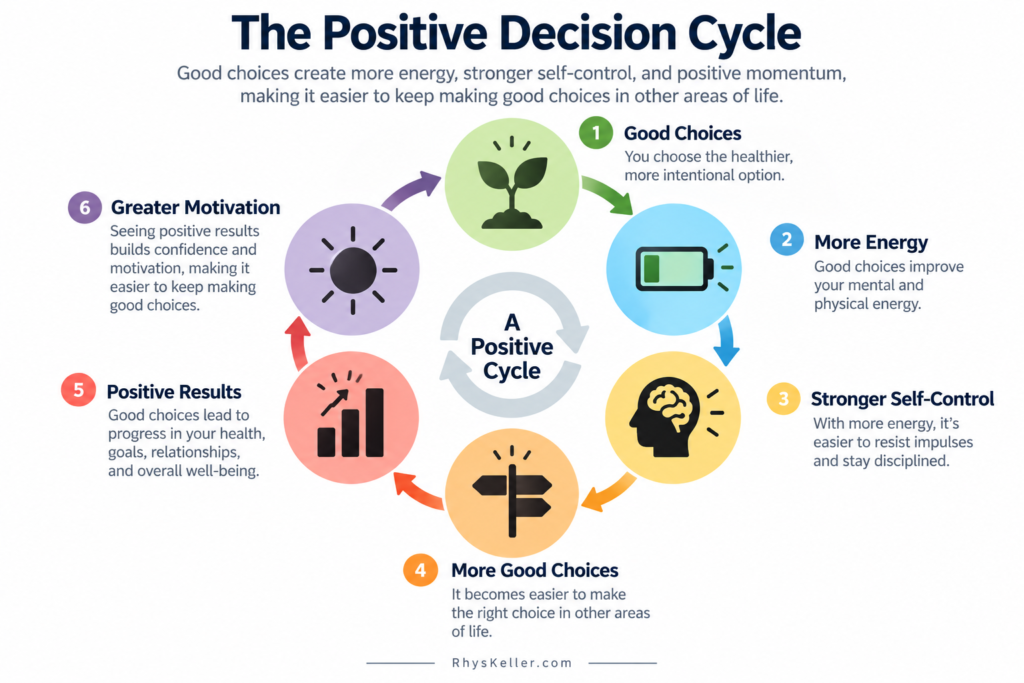
In fact, if you refer back to The Stress Decision Cycle I showed earlier, the easier we make good choices, the more likely those choices are to give us the energy and momentum to resist bad ones.
That’s why improving one small area tends to lead us to improving more areas.
It’s the cycle working in reverse to support good habits!
Run an Environmental Audit
You can make this practical.
Pick one behavior you want to change.
Don’t start with your entire life.
Choose something specific.
Maybe you want to exercise more.
Maybe you want to read.
Maybe you want to write.
Maybe you want to spend less time online.
Maybe you want to eat better.
Maybe you want to save money.
Then ask these questions.
What triggers the behavior?
When does it usually happen?
Where are you?
Who are you with?
What are you feeling?
What makes the behavior easy?
What is immediately available?
What requires almost no effort?
What do you automatically reach for?
What makes the behavior difficult?
What steps have to happen before you begin?
What decisions are required?
What obstacles repeatedly appear?
What could I remove?
What distraction, temptation, or unnecessary decision could disappear?
What could I place directly in my path?
What would make the behavior you actually want almost impossible to overlook?
These questions turn vague self-improvement into a practical design problem.
It’s like engineering your life to produce the results you want most.
Design Your Environment Around the Person You Want to Become
There is a deeper principle underneath all of this.
Your environment can reinforce your identity.
If you want to become someone who reads, make reading visible.
If you want to become someone who exercises, make exercise accessible.
If you want to become someone who writes, make writing easy to begin.
If you want to become someone who spends intentionally, make unnecessary spending inconvenient.
If you want to become someone who protects attention, remove unnecessary demands on it.
You are essentially creating physical and digital reminders of what matters.
This doesn’t guarantee that you’ll follow through.
But it changes the default.
And defaults matter.
Habit formation takes time, and the amount of time varies depending on the behavior and the person.
The important part is that repeated behaviors can become easier and more automatic over time.
And with better habits, better decisions can become easier, and better results become more likely.
The Power of Visual Triggers
What you see influences what you remember.
A book on your desk reminds you to read.
A guitar sitting in the corner reminds you to practice.
A water bottle beside your computer reminds you to drink.
A calendar showing a protected writing block reminds you that the time exists for a reason.
The opposite is true too.
A television positioned as the central feature of a room makes television an obvious activity.
A phone sitting face-up beside your computer invites checking.
A browser filled with entertainment tabs makes distraction immediately accessible.
You don’t need to consciously respond to every visual cue.
Many of them operate quietly in the background.
That’s exactly why they can be useful.
Recently, I positioned a bag of cookies in our pantry to be slightly so it was harder to see.
It wasn’t impossible to see, but it was harder.
Over the next few days, I forgot the cookies were even there.
Yesterday, that same bag was not only on the counter, but a tray of cookies was open and sitting beside it.
Just sitting there.
Beckoning me to respond.
And respond I did!
But not in the way I wanted.
It was simply another reminder that if we make the wrong choices easy, we may choose not to resist them.
But if we make the wrong choices hard, we may forget it’s even an option.
Environment and Delayed Gratification
Environmental design also makes delayed gratification easier.
This matters because many worthwhile outcomes take time.
You want to become healthier.
You want to build wealth.
You want to learn something difficult.
You want to write.
You want to develop expertise.
The reward isn’t immediate.
If your environment is filled with instant rewards, the long-term goal is constantly competing against something easier.
That is why The Psychology of Delayed Gratification belongs in this same ecosystem.
You don’t necessarily need extraordinary willpower to choose the future over the present.
You can make the present environment more compatible with the future you want.
But remember, don’t try to do it all at once.
Start with something specific. Something that directly affects what you’re hoping to achieve.
Then let positive reinforcement in that give you support to tackle something else.
Good Systems Reduce the Number of Decisions You Have to Make
Imagine having to decide every morning whether you’re going to exercise.
You wake up.
You’re tired.
You negotiate with yourself.
You consider skipping.
You think about how busy the day will be.
Eventually, you decide.
Now compare that with having a scheduled workout that is already part of your routine.
The second approach removes a decision.
That might sound insignificant.
Multiply it by hundreds of decisions over months and years, and it becomes much more meaningful.
This is why good systems matter.
They don’t make you disciplined.
They make discipline easier to practice.
I love how my wife schedules her workouts.
Not only does she schedule her participation at the fitness studio, she then adds it to the calendar, tells me when she’s going, and organizes the rest of her day around that fitness class.
While she may not consider it engineering her environment, that is exactly what she’s doing.
And she’s done it long enough for it to become her default.
Sure, things sometimes get in the way and require adjustments.
But the fact is that her routine helps her follow through and that routine has supported her goals for decades.
What Happens When Your Environment Works Against You
Sometimes the problem isn’t a lack of effort.
It’s that your system contains too many failure points.
In the engineering world, we call these conflict points.
Think about a real-world traffic intersection. Conflict points are every possible place cars can crash into each other.
It might be a car driving straight while another car is making a turn. Or it could be one car rear-ending the car in front of it if they weren’t paying attention.
A normal four-leg intersection might have 32 vehicle-to-vehicle conflict points. And if you add pedestrians to the mix, you’ve got a total of 56 for a single intersection.
That’s 56 ways something could go wrong that we try to safely design around.
Life has conflict points too and I dare say it’s far more than an intersection.
You need to remember too many things.
You have too many notifications.
Your workspace is cluttered.
Your schedule is unrealistic.
Your goals are vague.
Your food choices require constant restraint.
Your phone is always available.
Your work is interrupted constantly.
Your evenings have no structure.
Your sleep is inconsistent.
None of these problems looks catastrophic on their own.
But together, they create a system that makes good behavior increasingly difficult.
Eventually you start blaming yourself.
“Why can’t I just be more disciplined?”
But the real question we need to ask is
“Why have I designed my day so that the behavior I want requires constant resistance?”
Your Environment Doesn’t Determine Your Behavior
Your environment influences behavior.
It doesn’t control it.
People overcome difficult circumstances every day.
People make extraordinary choices in terrible environments.
People also make poor choices despite having excellent circumstances.
So environmental design isn’t an excuse.
It’s a lever.
You still have responsibility for your decisions.
You simply recognize that responsibility includes deciding what kind of environment you want to create.
Recognizing that matters to me because intentional living isn’t about blaming circumstances for everything that happens.
It’s about recognizing what you can influence and taking responsibility for it.
Sometimes the most responsible choice is changing yourself.
Sometimes it’s changing your surroundings.
Most often, it’s both.
What Your Environment Says About Your Priorities
Here’s a useful exercise.
Look around your home.
Look at your desk.
Look at your phone.
Look at your calendar.
Look at your browser.
Look at your subscriptions.
Look at where you spend your evenings.
Then ask:
“What do these things suggest that I value?”
You might discover something uncomfortable.
You may say you value reading but spend every evening surrounded by screens.
You may say health matters but make unhealthy food the easiest food to access.
You may say your family matters but allow work notifications to interrupt dinner.
You may say writing matters but have no protected time for it.
You may say financial freedom matters but make spending easier (or more celebratory) than saving.
This isn’t an exercise in guilt.
It’s an exercise in alignment.
Your stated priorities and your environment may never be identical.
But if they are radically different, the discrepancy is worth examining.
Small Environmental Changes Can Produce Large Results
You don’t need to move across the country.
You don’t need to quit your job.
You don’t need to buy expensive equipment.
You don’t need a complicated productivity system.
Just try changing one thing.
- Put your phone somewhere else.
- Put your book somewhere visible.
- Prepare tomorrow’s workout clothes tonight.
- Remove one distracting application.
- Turn off unnecessary notifications.
- Schedule one protected block for important work.
- Move unhealthy food out of immediate reach.
- Automate one financial decision.
- Clean the surface where you work.
Make the first step of an important habit easier.
Then observe what happens.
Think of it as an experiment.
You’re not trying to prove that you’ve become a different person.
You’re testing whether a different environment produces a different behavior.
What to Do When Your Environment Can’t Be Changed
Of course, some environments aren’t under your control.
You can’t always change your workplace.
You can’t control your children’s schedules.
You can’t redesign another person’s personality.
You can’t eliminate every stressful responsibility.
You can’t make the world stop sending distractions.
When you can’t change the larger environment, look for smaller environments within it.
- Create a focused workspace inside a chaotic office.
- Use headphones.
- Set boundaries around notifications.
- Choose when you check email.
- Keep healthy food available even if you can’t control every meal.
- Protect one small block of time.
Build a routine around the part of the day you can control.
You don’t need complete control to create meaningful influence.
In fact, aiming for complete control will lead to more stress because it’s unobtainable.
But small changes can be controlled and might just be the tweak you needed.
The Environment You Build Today Becomes Tomorrow’s Default
This may be the most important idea in the entire article.
Your environment doesn’t just influence today’s behavior.
It can shape tomorrow’s habits.
The decisions you repeat become routines.
The routines you repeat become normal.
What becomes normal requires less conscious effort.
And eventually, the environment and the behavior begin reinforcing each other.
That’s why small changes can compound.
You aren’t just making today’s decision easier.
You may be making the same decision easier tomorrow.
And the day after that.
Final Thoughts: Stop Fighting Your Environment
Willpower has its place.
There will always be moments when you need to make a difficult choice.
But you shouldn’t have to fight your surroundings every hour of every day.
If you are, something is wrong and needs to be corrected.
If your environment consistently encourages the behavior you don’t want, change the environment.
If your phone constantly interrupts your attention, create distance.
If your schedule leaves no room for what matters, redesign it.
If your workspace makes focused work difficult, change the workspace.
If your routines have accumulated unnecessary friction, simplify them.
If your surroundings make unhealthy choices easy and healthy choices difficult, reverse the equation.
This isn’t about creating a perfectly optimized life.
It isn’t about eliminating every temptation.
And it certainly isn’t about blaming your environment whenever you make a poor decision.
It’s about recognizing something we often overlook:
The easiest choice available is often the choice you make.
So make the right choices easier.
Put what matters within reach.
Move distractions farther away.
Reduce unnecessary decisions.
Create routines that support your priorities.
Build surroundings that reinforce the person you are trying to become.
Because discipline isn’t only what happens inside your head.
Sometimes the smartest thing you can do is change what’s around you.
And when your environment starts working with you instead of against you, you may discover that you didn’t need nearly as much willpower as you thought.
