Nearly everyone admires mastery. We gaze up at the musician who performs effortlessly. We scratch our heads at the craftsman whose work seems flawless. We’re inspired by the athlete who makes difficult things look ordinary or the author whose words flow naturally. Yet very few people ever reach that level. The difference usually isn’t talent. It’s that most people unknowingly quit long before mastery ever becomes possible. Mastery isn’t reserved for extraordinary people. It’s usually the result of ordinary people doing extraordinary things consistently for an extraordinarily long time.
What Is Mastery?
Mastery is the pursuit of exceptional competence.
Mastery only exists within a context of comparison. We recognize exceptional skill because we understand what average performance looks like.
An awareness of what’s average illuminates above-average.
Base expectations of what is commonplace a spotlight on what is rare.
Mastery is characterized by deep competence, refined judgment, consistent execution, and continual improvement.
Mastery is not perfect.
Nor is it knowing everything, never making mistakes, or being naturally gifted.
Perhaps one of the most interesting aspects of mastery is that it’s more of a direction than a destination.
Seeing someone who is a master in their craft is like getting a glimpse of them on a very long journey.
While they’ve already traveled very far, they continue traveling further.
If they were to ever stop, the very attributes and disciplines that helped them develop mastery would begin to erode and their incredible skill would undoubtedly regress towards average without intervention.
Why Most People Never Reach Mastery
Most people don’t fail to reach mastery because of one big reason.
They never get there because of many small ones.
1. They Confuse Interest With Commitment
Everyone enjoys the excitement of beginning.
Few embrace years of repetition.
While interest starts the journey, commitment progresses it.
When I and my three children started taking piano lessons, it was exciting.
Those initial lessons were basic, easy, and new skills were growing exponentially.
The first month of practicing at home was more fun than burdensome.
A year into it, the growth trajectory slowed down.
Practice was no longer about finding middle-C.
It was trying to memorize a song, or move hand positions between neutrals and sharps.
The same experience repeats itself with almost every endeavor.
In writing, the idea of a strong article is exciting until 500 words and 2 hours later it’s not connecting. The same pattern has played out throughout the careers of many successful creators, including Dr. Seuss, whose path to success took far longer than most people realize.
In weightlifting, the slow pace of muscle growth separates the wheat from the chaff.
Learning a new language is no different. The new words and phrases are exciting but fluency only comes from a long grind.
2. They Chase Novelty Instead of Depth
Modern life rewards starting.
Mastery rewards staying.
There is nothing wrong with chasing novelty unless your priority is depth.
If you want to be able to pluck a few guitar chords, tap a few piano jingles, and keep a steady drum beat, just a little time on each is all that’s required to achieve your goals.
But if you want to draw from a deep well of memorized songs and read complex music sheets smoothly, it requires dedication.
Dedication to one is mutually exclusive with dedication to another.
The world we live in is oversaturated with physical and digital distraction.
Distraction leaves us dealing with constant stimulation and context switching, two ingredients that actively oppose mastery.
At our fingertips and just about anywhere we look are opportunities to start new hobbies, implement new productivity systems, test new apps, and leverage new AI.
But, while this novelty constantly causes you to reset, discipline cultivates a focused depth that compounds.
3. They Quit During the Invisible Middle
Beginning is exciting.
Finishing is rewarding.
The middle is lonely.
Think about a marathon.
Runners start with the loud bang of a gun, cheering, and high-fives. The end with ribbons, medals, cheering, and hugs.
Between those two points was a lonely, invisible, grind that made them want to quit.
The invisible middle isn’t talked about much. It’s not part of the new gym contract. It’s not explained at the complimentary beginner lesson.
The invisible middle is the vast majority of the journey to mastery.
For me, it’s the 5am workouts in my garage, 20 minute Friday night piano homework, and lunchbreak blogging.
For you, maybe it’s a walk around the neighborhood when the blazing sun keeps most people indoors.
Maybe it’s a late-night college class, coffee with a mentor, or another audiobook during your commute.
Those who don’t reach mastery hit a plateau and decide the juice wasn’t worth the squeeze.
The slow improvement and delayed gratification required to keep going were too much resistance to push through.
This part of the mastery journey is often referred to as The Dip, or the Valley of Disappointment.
Both phrases seek to address the same phenomenon:
The excitement of starting is followed by a long period of difficulty where hope and reality clash.
The excitement of finishing, or reaching a level of mastery, is only attained as a reward for pushing through the difficulty.
4. They Mistake Practice for Deliberate Practice
Doing something repeatedly doesn’t guarantee improvement.
Playing Happy Birthday on the piano twice a day for a month will make you very good at playing Happy Birthday.
It won’t help you play Rush E.
Lifting 5 pound dumbbells 100 times a day will make you exceptional at lifting 5 pounds.
It won’t make you the person everyone asks to help move their couch.
We can practice something long term and never reach mastery if we don’t reflect on our goals, gather feedback, and stretch our weaknesses.
Practice makes permanent.
Deliberate practice makes progress.
The difference is intentional living.
5. They Depend on Motivation
Mastery requires consistency.
Consistency requires discipline.
Motivation fluctuates due to both internal and external factors.
This is why discipline often beats motivation.
Motivation is like not like the tide, which comes and goes in regularity.
It’s more like a wave, sometimes crashing with power and other times disappointingly gentle.
I saw this recently on a beach trip with my family.
Me and my boys were trying to catch waves to body surf.
While waves were constant, most were never big enough to surf on.
Some waves looked great at a distance but crashed too soon or mellowed out.
The effect of the waves were unpredictable.
Motivation works the same way.
If our growth depends on how someone else feels, the impact of their motivating force will be unpredictable.
We will never have impactful consistency.
And without consistency, mastery will always be out of reach.
6. They Fear Looking Incompetent
One of the biggest barriers to mastery is the fear of being judged.
Adults desperately avoid situations where they can be criticized, embarrassed, or labeled a beginner.
I say adults specifically because we don’t see this same fear in children until they reach a certain age.
Young kids love trying things.
As proof of this point, I am typically the one holding my own kids back from doing things because of my fear of their perceived incompetence.
Of course no one starts out an expert.
But the tragedy isn’t starting, it’s being too afraid to start.
We don’t want to hand a kid a wrench and tell him to change the car battery.
But we could help him start learning the process with unscrewing the cap, or opening the car hood, or seeing which terminal is positive or negative and in time maybe that kid could change the car battery all by themselves.
As adults, we hold ourselves back like it’s our job.
New machine in the gym? Let someone else look like a fool first.
New recipe for friends? Just make the same old thing you always do.
Invitation to golf? Stick to put-put, it’s what you know (guilty!).
Mastery requires repeated exposure to imperfection.
It’s like walking around with a magnifying glass on our weak spot with a sign that says “Look here, folks, right here!”
No wonder we love average.
It’s so safe and comfortable.
And no one looks at us and says, “Wow, you’re really terrible at that. So terrible I’m surprised you even tried.”
Instead they say, “Hey look, they’re just like me, no better or worse.”
If only we traded a little bit of fear for a little bit of mastery.
Then I wonder what they might say.
“Wow, that’s really something, look what they’ve done, look how brave they are, maybe I could do something like that.”
7. They Never Stay With One Thing Long Enough
I’ve kept a monthly budget for 14 years.
I’ve graphed my assets versus liabilities over that whole time.
I can see the trends.
I know where the money leaks are and where we’ve been rock solid.
With the help of AI, I can now interpret, project, and analyze the data like no one else in mere seconds.
What if I gave up after month one?
Or what if I only tracked month one, seven, and forty-two?
How helpful would that be in my pursuit of responsible freedom?
Mastery thrives with discipline because discipline compounds.
Three years of piano lessons aren’t year one repeated two more times.
You’ve already got the basics figured out.
The foundation is laid.
Skill now compounds in years two and three.
People who give up quickly never let the magic of compounding do its work.
If they would only stick with it a while longer, get past the basics, get past building the foundation, the walls, the roof…imagine the mastery they might build.
If you stick with someone for a year, I guarantee people will notice your growth.
Stick with it for three years and you’ll be far beyond average.
Hang on for 10 years…20 years…mastery will be undeniable.
Curiously, most people overestimate what they can accomplish in a month.
But they dramatically underestimate what consistent effort produces over decades.
The Mastery Trap: Becoming Good Enough
This is a phenomenon that almost everyone experiences but few discuss.
The progression can look like this:
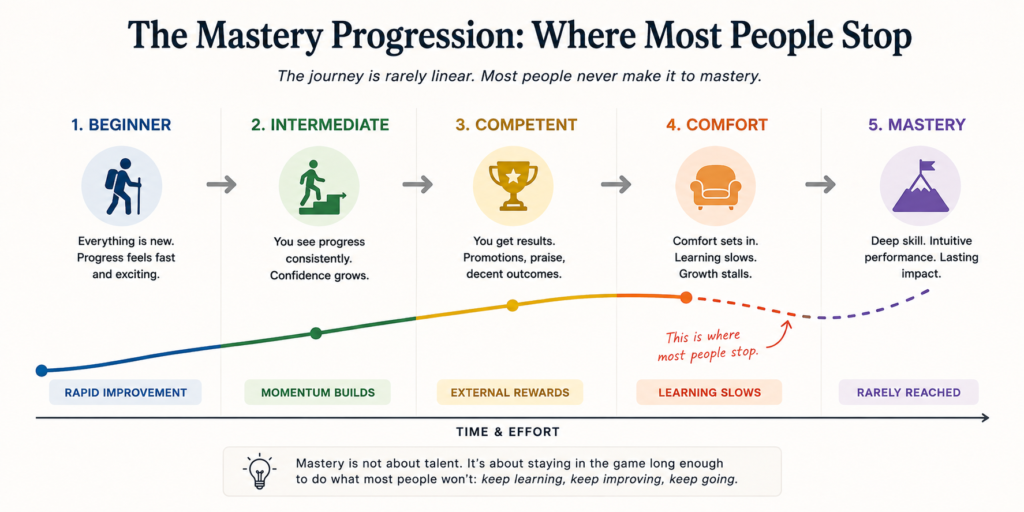
Many people don’t quit outright. They simply become good enough. Their career, hobby, or craft no longer demands improvement, so they plateau for years or decades. Sometimes the hardest thing to recognize is that being comfortable with where you are can quietly become the reason you never discover what you could become.
Sometimes the way forward isn’t simply to practice more. It’s to recognize that you’ve outgrown the approach that got you here.
The single biggest key to push past comfort towards continued mastery is personal conviction.
You must reflect on why mastery matters.
Stopping is not always wrong or bad, as long as it aligns with your convictions to quit pursuing a specific goal.
But knowing learning slows, growth stalls, and comfort sets in is a game changer in how prepared you can be to push through it.
If you’ve ever reached this level of skill development, I would love to hear about it in the comments. Tell us if you pushed through it or intentionally decided to stop.
The Hidden Cost of Never Reaching Mastery
Not pursuing mastery costs more than we realize.
It’s not money or status.
Identity.
Confidence.
Freedom.
Contribution.
Mastery allows us to help others in ways beginners cannot.
It allows us to live up to our fullest potential.
Mastery lets us earn all we can, help all we can, be all we can, and do all we can with the small amount of time we’ve got.
Now, many people get this part twisted.
Mastery isn’t a select group of skills that fit neatly in a box we all agree on.
Mastery can be in anything.
But it can’t be in everything.
We do have to pick and choose what pursuits are worthwhile to us.
We must determine our own priorities and decide how to spend the precious time we have on the things that matter most to us.
I once went on stage to be a magician’s prop. He was masterful and I have the picture to prove it.
I’ve seen people train their pets with such mastery, dogs walk around holding their own leash in their mouth.
My oldest son became such a master at solving Rubik’s Cubes we would often say “Let my son show you something amazing.”
My father is such a master programmer I don’t even understand half of what he’s working on in his spare time.
My father-in-law is such a master craftsman I couldn’t believe the remodeling he did at his local church.
My wife is a master at showing our kids a fun time. Boundless energy, spontaneity, and creativity.
There is all sorts of mastery.
None less or more valuable than another.
We need masters of their craft in all areas of life.
But each and every one has taken years of pushing through the difficult middle.
The real cost of never reaching mastery isn’t only personal.
It’s societal.
Imagine a world where everyone is just average.
Sure, things work OK, but it’s all void of that special something extra.
We need people who know who they are, can do extraordinary things, and have the confidence to contribute to others in meaningful ways.
What Masters Actually Do Differently
Masters are marked by very specific attributes which cause them to stand out in the crowd.
They embrace boredom, knowing it cultivates an environment of creativity and reflection.
They seek feedback, fearing being mediocre more than being judged.
They repeat the fundamentals, and so build a solid foundation for something magnificent.
They think long term, measuring their own progress over years not weeks.
They stay curious, wondering what they might be able to achieve if they keep trying.
They remain humble, knowing that accepting the reality of where they are is the surest way to know where to go next.
My experience with Picture Book Critique Fest reinforced how powerful that feedback can be, especially when experienced writers, illustrators, and publishing professionals help you see weaknesses in your work that you could not see yourself.
Notice each of these attributes are available to you and everyone else.
These attributes can be developed and matured.
They may not all be easy, but they are all attainable.
Mastery in the Age of AI
Information is abundant.
Execution isn’t.
It cannot accumulate experience.
It cannot develop judgment for you.
That distinction matters because intelligence alone doesn’t guarantee good judgment or good decisions.
It cannot perform years of deliberate practice on your behalf.
As AI lowers the cost of information, mastery becomes more valuable because genuine expertise increasingly depends on discernment rather than access to knowledge.
Too often I hear “AI said this”.
Less and less I hear “This is what I think based on what I know, what I’ve experienced, and what I’ve researched.”
I’m not afraid of a future where AI is integrated into all aspects of life.
Where there is ambition and a desire for mastery, people will find ways to bring value to the marketplace and cultivate enriching lives.
What I am afraid of is the temptation to do less, to achieve less, and to strive for less because AI makes so many things easier.
AI is just another tool in a long line of powerful revolutions that help separate the wheat from the chaff.
We know from history a hard worker isn’t always a smart worker.
A man who plows his farm by hand for 8 hours isn’t held in higher regard than the neighbor who uses a machine to accomplish it in one.
But a man who, through years of cultivated skill, knows how to keep the machine running is held in high esteem.
AI is our modern machine.
Those who seek mastery would be wise to understand it and through cultivated skill learn how and when to leverage it.
I’m researching how people are navigating that choice through my Human-AI Use Survey, which explores what people are choosing to delegate to AI and what they’re deliberately choosing to keep doing themselves.
How to Begin Pursuing Mastery
It all sounds great, right?
Now you must decide what to do about it.
If you’re serious about pursuing mastery, and I mean really serious, here are my practical tips for you:
- Choose fewer things.
- Practice consistently.
- Seek feedback.
- Measure years, not weeks.
- Protect your attention.
- Expect plateaus.
- Stay humble.
- Keep showing up.
As a church pastor of mine often says, “I don’t write the mail. I just deliver it.”
Maybe you don’t want to do those eight things.
Maybe they’re boring.
Maybe they’re too simple.
Those thoughts may be true.
But it doesn’t change reality.
If you want to pursue mastery, focus on doing those eight things.
Then come back here and let me know how it’s gone for you.
I’d love to hear the success stories years from now and know I was a small part of your journey in the right direction.
Final Thoughts
Mastery is one of the few pursuits whose value continues increasing throughout life.
Most people never reach it because they quit too early, scatter their attention too widely, or mistake activity for progress.
The encouraging truth is that mastery doesn’t require extraordinary talent.
It requires extraordinary faithfulness to ordinary actions repeated over a very long time.
Every day you choose depth over novelty, deliberate practice over passive repetition, and consistency over intensity, you move one step closer to becoming the kind of person whose work speaks for itself.
