Creative blocks can be frustrating, especially when your work depends on creating ideas, solving problems, or producing original work. Writers, illustrators, entrepreneurs, and creators of all kinds eventually encounter periods where progress feels impossible. While creative blocks often feel like a lack of inspiration, they are frequently the result of stress, mental fatigue, routine, or overstimulation. Fortunately, overcoming a creative block does not always require forcing ideas into existence. In this guest article, author and illustrator Lisa Wee shares a simple strategy that has repeatedly helped her break through creative stagnation: taking a walk.
When you buy through my links, I may earn money from my affiliate partners. Learn more.
Key Takeaways
- Creative blocks happen to writers, illustrators, and creators at every experience level.
- Walking can help break repetitive thinking patterns and create space for new ideas.
- Changing your environment often stimulates creativity more effectively than forcing inspiration.
- Short walks can improve mood, reduce stress, and help restore mental clarity.
- Creative progress often comes from stepping away from the problem rather than obsessing over it.
Meet Author and Illustrator Lisa Wee
Today’s guest post comes from Lisa Wee, a debut author / illustrator of Li Na is my Name, published by Dixi Books Publishing, UK. Lisa has illustrated several picture books for prominent organizations and self-published authors. Her quaint, quirky and vibrant illustrations are inclusive and embrace diversity in celebrating the lives of children from all walks of life. Her clients include Celebrity Top Chef Kristen Kish, Babybug magazine for January 2022 and February 2022 issues, Ladybug magazine Fall 2021 issue, and World Vision International, International Day of the Girls campaign 2021. You can also find her on X @LisaWee1970 and Instagram @Lisa_WeeIllustrator.
Creative Blocks Happen to Everyone
We’re often taught to try harder and push through it.
Sometimes, a brute force approach does work but in most cases, it becomes a vicious cycle of recrimination.
Our mind loops a recording of “You are NOT good enough…You are NOT that creative…You should QUIT!”
Some of us have heard it so many times, it can manifest physical pain and feelings of creative suffocation.
Whenever a creative block knocks on the door, it’s time to take a walk.
Seriously. A walk.
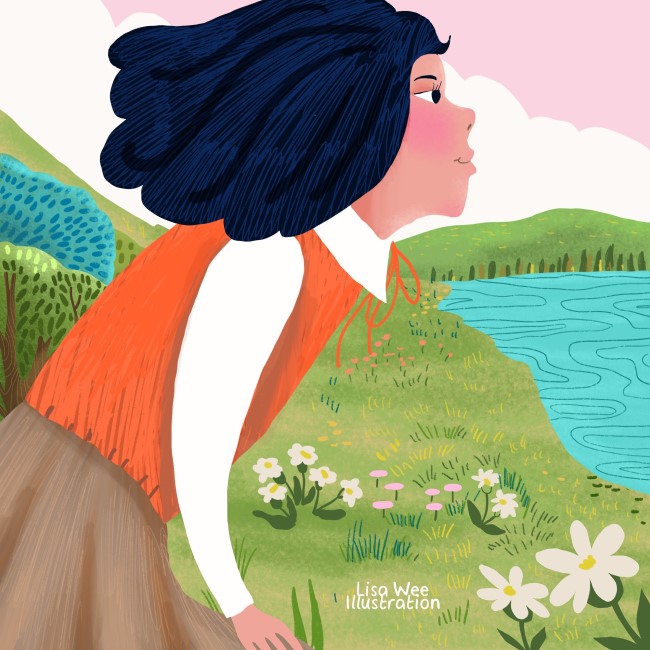
When we consciously choose to get out of our comfort zone and take walks to places we have never been before or have not been for a while, it creates an opportunity to open our mind and provides us with a new range of inspirations.
It could be a high street, a nearby park, museum exhibition or even a local café.
These dynamic environments help to rewire our mindset and replaces stuck thinking with fresh thinking.
Going for a walk activates the right side of our brain and triggers our creative neurons.
When our mind is free of worries, we tend to live in the moment and experience mindfulness. We become conscious of the sensations and stimuli all around us.
Change the Routine
It’s easy for us to have a pattern of routine.
Our routines allow us to find comfort and ensure the feel of security.
Unfortunately, this habitual humdrum way of living can work against us when we need to find a new solution to a new problem.
By taking walks, we change our environment to break these mundane habits.
We think divergently and enlarge our creativity.
Walks can cause us to experience intuitive moments when suddenly a solution pops into our heads out of nowhere.
Why Walking Helps Creativity
Walking does more than provide exercise.
It creates distance from the problem.
When people remain seated at the same desk staring at the same challenge, the brain often continues following the same mental pathways that created the block in the first place.
A walk introduces novelty.
New sights.
New sounds.
New conversations.
New observations.
Even a short change of environment can help interrupt repetitive thinking patterns and create space for new ideas to emerge.
This is one reason so many writers, artists, inventors, and entrepreneurs throughout history have relied on walking as part of their creative process.
Endorphins are Better than Coffee
The act of walking activates endorphins; the happy hormones. This, in turn, creates a positive mindset and relaxes us.
Walking has helped me to overcome my creative block many times, especially in times of big deadlines when I feel I don’t have the energy or time for walks.
Time and time again, with just 10 to 20 minutes of walking, my mind recalibrates and rejoices.
In the end, the result of the work became better than what I expected.
Creative Blocks Happen to Every Creator
One of the most encouraging lessons from conversations with authors, illustrators, and creators is that creative blocks are normal.
Even experienced professionals encounter periods where ideas feel scarce and progress slows.
The difference is not that successful creators avoid creative blocks.
The difference is that they develop strategies for working through them.
For Lisa Wee, walking became one of those strategies. For others it might be journaling, reading, sketching, changing environments, or talking through ideas with a trusted friend.
The important thing is continuing to create rather than allowing temporary frustration to become permanent inactivity.
Final Thoughts
Creative blocks often convince us that something is wrong with our ability, talent, or future potential. In reality, they are usually a temporary part of the creative process.
Lisa Wee’s advice is refreshingly simple: when ideas stop flowing, step away from the desk and take a walk.
Sometimes the fastest way forward is creating enough space for new ideas to find you.
