The right life isn’t necessarily the most luxurious life, the most productive life, the most adventurous life, or the most financially successful life. It is the life that fits what matters to you while remaining grounded in reality, responsibility, and the consequences of your choices.
Freedom gives us choices. Responsibility helps us use those choices well.
Determining the right life for you begins with three questions:
- What does it actually mean to be free?
- What responsibilities am I willing to accept?
- Why might responsibility be one of the things that makes freedom not only possible but worthwhile?
What Is Responsible Freedom?
Responsible Freedom is the ability to direct more of one’s life intentionally while accepting the responsibilities required to sustain that freedom.
In simpler terms, it means building enough capability, resources, wisdom, and discipline to make meaningful choices about your life while accepting the responsibilities and consequences that come with those choices.
Responsible Freedom isn’t freedom from responsibility. It is freedom strengthened by responsible choices.
What Does It Mean to Be Free?
We want freedom, but what do we mean by it?
Freedom and responsibility are often treated as opposites, but they don’t have to be.
Most of us want some combination of:
- control over our time
- financial flexibility
- meaningful work
- physical capability
- strong relationships
- room to learn and create
- the ability to make our own decisions
- freedom from unnecessary obligations and distractions
Work optionality is one useful example.
The goal isn’t necessarily to retire as early as possible or to stop working altogether. A more meaningful milestone may be reaching the point where work becomes optional.
At that point, you might leave your career. You might start something entirely different. You might reduce your hours. Or you might continue doing the same work because you still find it worthwhile.
That distinction matters. Freedom isn’t necessarily having nothing to do. It is having greater say in what you do.
The important difference is that you are no longer working solely because you have to.
Financial freedom, in this sense, isn’t primarily about escaping work. It is about gaining the freedom to decide what role work should play in your life.
However, there’s a problem with these ideas about freedom.
We often define freedom as having fewer constraints.
The more obligations we eliminate, the freer we assume we’ll become.
Yet some of the things that appear to restrict freedom are actually what make greater freedom possible or life more enriching.
Money requires stewardship.
Health requires maintenance.
Relationships require commitment.
Mastery requires practice.
Attention requires boundaries.
Character requires discipline.
So perhaps freedom isn’t simply the absence of responsibility.
Perhaps responsibility is part of the infrastructure that makes meaningful freedom possible.
That is the question behind Responsible Freedom.
Freedom Without Responsibility
If freedom means:
“I can do whatever I want.”
Then freedom can easily become:
- impulse
- distraction
- excess
- avoidance
- short-term gratification
- dependence on convenience
Someone can have unlimited entertainment and become less free.
Someone can have unlimited information and become less capable of deciding.
Someone can have unlimited choices and become paralyzed by analysis.
Someone can have financial freedom and still be controlled by consumption.
Someone can have enormous amounts of time and waste it.
Having more options doesn’t automatically make us more free.
True freedom requires the ability to use available options wisely.
Responsibility Without Freedom
Responsibility can also become distorted.
If responsibility means:
“I must fulfill every obligation placed in front of me.”
then responsibility can become:
- legalism
- perfectionism
- burnout
- people-pleasing
- endless obligation
- living according to someone else’s priorities
If an employee tries to embrace every responsibility their company asks of them, other aspects of their life suffer.
If a parent takes on too much responsibility, their energy and presence for their children can run dry.
If a friend takes on responsibility for keeping other people happy, their own priorities can gradually disappear.
Being responsible is more than owning tasks.
Responsibility means wisely understanding which obligations are actually yours and accepting an appropriate level of responsibility for your life.
The right level of responsibility for you may require a great deal of work, or it may require very little.
Responsible Freedom isn’t responsibility replacing freedom.
It is the pursuit of both.
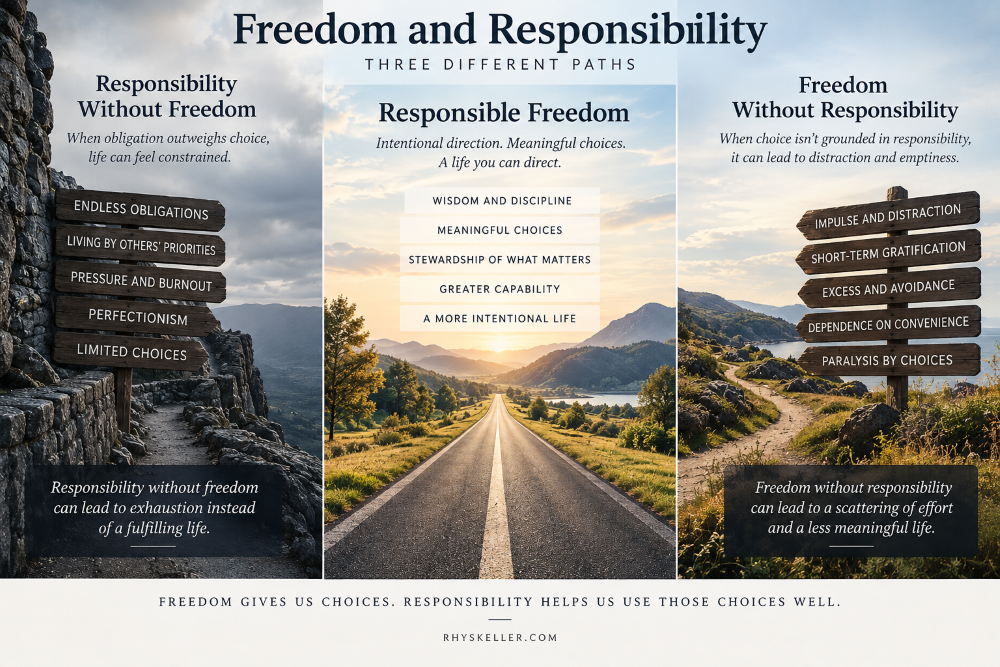
The Tension Between Freedom and Responsibility
Consider how this tension works in your life like this:
Responsibility without freedom ← Responsible Freedom → Freedom without responsibility
The goal isn’t to find some mathematically perfect midpoint.
The goal is to build enough capability, wisdom, and stewardship that you can direct your life intentionally while faithfully handling what you’ve been given.
There are four important ideas contained in that definition.
Direct more of one’s life.
This is autonomy, agency, intentionality, choice.
Freedom becomes more meaningful as our ability to direct our own time, resources, attention, work, and relationships increases. This doesn’t mean controlling everything around us. It means increasing our ability to make meaningful choices within the circumstances we actually face.
Directing our own lives also requires taking responsibility for the reasoning behind our decisions.
If you need money, you may be required to work for a specific level of pay.
If you don’t need money, you may decide to not work, work less, or work somewhere else.
This is why optionality matters. Someone with lower recurring expenses, diversified income streams, or improved health may have a greater ability to direct their life their way. Optionality means having more meaningful choices about what you do.
Without optionality, we must do this, or we have to do that.
Intentionally.
This distinguishes freedom from impulse.
Intentionality means considering what we value, what our choices will require, and what consequences they may create before simply choosing what feels easiest or most appealing.
I may be free to walk into my kitchen pantry and eat anything I see, but should I?
Intentional decisions weigh the impacts.
Eating anything I see, like my kids’ favorite Panda Cookies, might feel good and be OK.
Or it might conflict with my personal goals or cause my children to go without until the next grocery trip.
Responsible Freedom takes consequences and benefits into account.
Not just for me, but for those who may be affected.
Accepting responsibility.
Freedom doesn’t eliminate responsibility. Greater freedom often creates greater responsibility because we have more control over what we choose to do with our resources, time, abilities, and opportunities.
A parent has responsibility to care for their child, not just in a financial sense, but holistically.
A neighbor has responsibility to the people living around them.
A business owner has responsibility to follow the law.
But there are also many responsibilities that may not apply to us.
Such as an employee not being responsible for creating company policy.
Or a homeowner not being responsible for where recycling goes after it’s picked up by the garbage truck.
Accepting responsibility should be reasonable and appropriate to our circumstances and abilities.
Required to sustain that freedom.
This is the crucial piece.
The responsibilities we accept aren’t merely the price of freedom.
Some of them are what create it.
The choices that create freedom in the future often require responsibility in the present.
Responsible Freedom isn’t simply having more choices. It requires the wisdom to choose well, the responsibility to steward what you’ve been given, and the discipline to practice what matters.
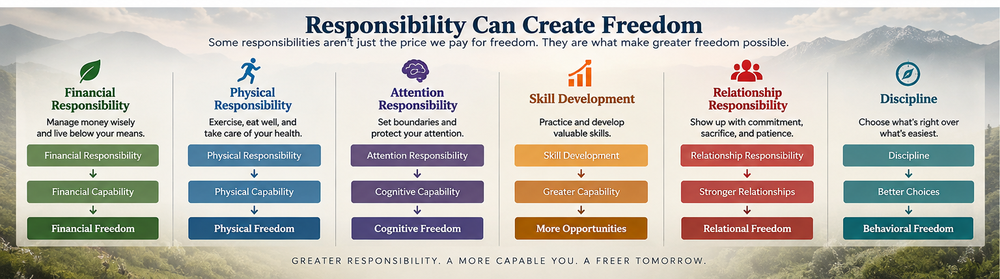
Responsibility Can Create Freedom
Over a decade ago my wife became a stay-at-home mom.
That freedom for her also became a responsibility for me.
As a single-income family, I accepted the responsibility to be the financial provider while she accepted the responsibility for being the primary caretaker for our children while I am at work.
The responsibility to provide enables the freedom to be home.
There are similar tradeoffs in other areas of life:
Financial responsibility creates financial freedom
Responsible money management can create freedom from financial dependence and unnecessary debt. Saving, spending intentionally, investing, building useful assets, controlling unnecessary debt, and developing sources of income that aren’t completely dependent on your immediate labor can create future choices. The more control you have over your financial resources, the more flexibility you may have over your work, spending, and future decisions.
Physical responsibility creates physical freedom
Taking care of your body preserves your ability to move, work, play, travel, and participate in life. Responsible eating, exercise, sleep, and recovery can expand what your body remains capable of doing as you grow older.
Attention responsibility creates cognitive freedom
Attention is one of the clearest examples of responsibility creating freedom. If you don’t decide where your attention goes, other people, platforms, algorithms, notifications, and competing demands will increasingly make that decision for you. Protecting your attention therefore isn’t merely a productivity technique. It is a way of preserving your ability to choose what deserves your mind.
Skill development creates freedom
Learning and practicing valuable skills expands what you are capable of doing. Greater capability creates greater optionality because you have more ways to solve problems, create value, earn income, pursue interests, and contribute to others.
Relationship responsibility creates relational freedom
Freedom isn’t the same as independence. A person can eliminate obligations and still build a profoundly impoverished life. Relationships require commitment, sacrifice, patience, and responsibility, but those commitments can create forms of freedom that independence cannot provide: trust, belonging, shared experiences, support, and the ability to give and receive love.
Discipline creates behavioral freedom
Discipline allows you to act according to your convictions rather than constantly according to your immediate feelings. The ability to do what matters even when you don’t feel like doing it creates freedom from being controlled by every passing impulse.
Freedom Requires Stewardship
We aren’t owners of unlimited resources.
We have finite:
- time
- attention
- energy
- money
- physical capacity
- relationships
- talents
- opportunities
The question isn’t:
“How can I get more of everything?”
It’s:
“How should I use what I have?”
This concept boils down to stewardship.
Stewardship is taking appropriate care of what you’ve been given and using it wisely.
Responsible Freedom begins with recognizing that these resources are finite. We cannot maximize everything, pursue every opportunity, or give equal attention to every responsibility. Stewardship requires deciding what deserves our care and what does not.
Stewardship isn’t simply using your resources efficiently. It also means preserving them. Time, attention, energy, and physical capacity are not infinitely renewable. Responsible Freedom therefore requires knowing when to work, when to recover, and when continued effort would begin consuming the very resources that make future freedom possible.
A useful question is:
Am I being a good steward of this limited resource?
Freedom Requires Wisdom
Freedom and choice are not the same thing.
More information creates more options.
More technology creates more options.
More money creates more options.
More time creates more options.
But options don’t tell us what to choose.
Wisdom helps us determine which choices are actually worth pursuing.
Information expands possibility. Wisdom helps us steward possibility. Responsible Freedom emerges when greater freedom is matched by the wisdom to use it well.
The more freedom we have, the more important good judgment becomes. Having choices is useful only if we can distinguish between choices that serve what matters and choices that gradually undermine it.
This is one reason intelligent people can still make bad decisions: intelligence can expand our ability to analyze a choice without necessarily improving our judgment about what we should do.
Wisdom asks:
- Is this true?
- Is this good?
- Is this worth pursuing?
- What deserves my attention?
- What deserves my effort?
- What kind of person will this choice make me?
Technology creates another version of this tension. A tool can give us more freedom by reducing unnecessary work, but greater capability does not automatically mean better choices. Responsible Freedom asks not only what technology can do for us, but what we should continue doing ourselves. Some forms of effort create the judgment, skills, relationships, and character we need to remain capable of directing our own lives.
More options can be valuable, but Responsible Freedom isn’t simply the ability to choose any option. It is the discernment to recognize which choices are worth pursuing.
Just because we’re free to choose doesn’t mean all options are equal.
Nor does it mean all options will lead to more freedom.
It may be justified to purchase something special.
But what if that something special locks you into 5 more years of debt?
Freedom to choose and choosing freedom are not the same thing!
Choosing freedom means considering not only what an option allows you to do today, but what that choice will make possible or impossible tomorrow.
Building a life of freedom requires wisely navigating the choices before you and building a life of future choices you want to have.
Freedom Requires Practice
We become what we repeatedly practice.
Outsourcing thinking can change what we practice, while intentionally using tools can preserve judgment, creativity, responsibility, and other human capabilities.
Every day we’re practicing something.
Our repeated choices gradually shape our capabilities, habits, character, and future options. What feels like a small decision today can become a meaningful constraint or advantage years later.
We’re practicing:
- attention or distraction
- discipline or avoidance
- consumption or creation
- learning or passivity
- stewardship or waste
- connection or isolation
- courage or comfort
What we repeatedly practice eventually affects what we’re capable of doing.
The freedom we have tomorrow is heavily influenced by what we choose to practice today.
The Six Areas of Responsible Freedom
These six areas of life contribute to our ability to live freely and responsibly.
They are not separate projects to optimize independently. Each affects the others, and weakness or strength in one area can change the choices available in another.
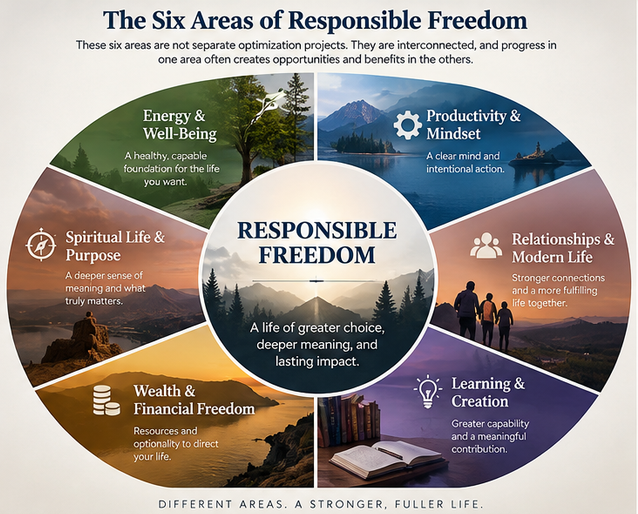
1. Energy & Well-Being
How do I preserve the physical and mental capacity to live the life I want to live?
Physical and mental capacity determines which opportunities you can realistically pursue and how fully you can participate in the life you’ve built.
2. Productivity & Mindset
How do I direct my time and effort toward what matters?
Directing your time and effort well creates room for the responsibilities and priorities that matter most.
3. Relationships & Modern Life
How do I remain deeply connected to people while navigating an increasingly distracted world?
Freedom isn’t meaningful if greater independence leaves you disconnected from the people you love and the communities you belong to.
4. Learning & Creation
How do I continually develop my capabilities and create something meaningful?
Developing your capabilities increases what you can contribute and expands the range of choices available to you. Capability is a form of freedom. The more you can understand, create, repair, communicate, solve, and contribute, the less dependent you are on circumstances or other people for every outcome.
Freedom grows not only through what we consume, but through what we become capable of creating. Learning without application can expand knowledge without expanding capability. Creating, practicing, building, writing, and contributing turn knowledge into ability, and ability creates more choices.
5. Wealth & Financial Freedom
How do I steward money and resources so they expand rather than restrict my choices?
Financial resources can create optionality when they are stewarded wisely rather than simply consumed to increase our lifestyle.
6. Spiritual Life & Purpose
What ultimately gives direction and meaning to the freedom I’m trying to build?
Freedom ultimately requires a reason for choosing one direction over another, because more options alone cannot tell us what is worth pursuing.
Your financial decisions affect your work.
Your work affects your energy.
Your energy affects your relationships.
Your attention affects your learning.
Your learning affects your capabilities.
Your beliefs affect how you decide what all of it is for and what legacy you want to leave behind.
Responsible Freedom is the intersection of all those things.
Responsible Freedom Isn’t About Optimizing Everything
Responsible Freedom doesn’t mean:
- maximizing every hour
- becoming maximally productive
- eliminating every inconvenience
- accumulating the most money
- optimizing every habit
- pursuing mastery in everything
- avoiding every obligation
- creating a perfectly controlled life
Because that would simply replace one form of captivity with another.
You cannot maximize everything.
Every choice involves tradeoffs. Responsible Freedom means accepting some constraints because they protect something you value more.
Being responsible might mean turning down lower-priority opportunities so you have more capacity for what matters most.
You must choose what matters.
Responsible Freedom Means Choosing What Matters
Freedom isn’t more choices.
It is increasingly the capacity and wisdom to choose among those choices well.
Freedom does not mean responding to every demand. It means having enough clarity to distinguish what is urgent from what is important, and enough discipline to give your resources to what actually matters.
A free life therefore isn’t defined by how many options you keep open. It is defined partly by your ability to recognize which options are worth pursuing and which ones are worth giving up.
And that means saying:
- yes to some things
- no to others
- this matters most
- not now
Responsible Freedom is therefore partly about intentional constraint.
You willingly accept certain responsibilities because they protect something more valuable.
For example:
I limit my spending because I value financial independence.
I practice my instrument because I value mastery.
I protect my attention because I value thought.
I invest in relationships because I value people.
I exercise because I value future capability.
I write because I value understanding and contribution.
That’s freedom expressed through my personal responsibility.
What Responsible Freedom Looks Like in Everyday Life
So what does Responsible Freedom actually look like in everyday life? Here are a few examples.
The financially free person
Doesn’t simply have money. They have built habits that preserve financial options.
This often shows up with personal finance skills, an understanding of investing and insurance, and budgeted plans for their future.
This can create a life less focused on worrying about how to make ends meet and more focused on what those financial capabilities make possible.
The physically capable person
Doesn’t simply “have health.” They have accepted the responsibility of maintaining their body.
This may include what they eat, how active they are, and what their sleep routine generally looks like.
This results in a life of greater physical capability: hiking one day, walking the neighborhood the next, playing with their children, or lifting heavy things with confidence.
The thoughtful person
Doesn’t simply have access to information. They have learned to discern what deserves attention.
They might value solitude, quiet time, journaling, or deep conversations one-on-one.
This gives them the time and space to consider and reflect on things they value.
The disciplined person
Doesn’t eliminate discomfort. They become capable of acting despite it.
They can appear focused and ambitious even though no one is telling them what to do.
Their discipline gives them greater ability to direct their time and effort toward what matters rather than constantly reacting to whatever feels easiest.
The creator
Doesn’t outsource every difficult part of creation. They use tools while preserving the parts that require their judgment and experience.
They understand technology can remove unnecessary friction while human judgment, responsibility, creativity, and lived experience remain ours.
This unique value is what they bring to the marketplace, community, and relationships, enabling others to benefit from what they create.
This Is the Beginning, Not the Conclusion
Responsible Freedom isn’t a single habit or a ten-step productivity system.
It’s a way of thinking about how we build our lives, whether we are doing so deliberately or simply allowing our choices and circumstances to shape us.
Over time, I want to explore what Responsible Freedom looks like in our attention, energy, work, relationships, learning, finances, creativity, faith, and purpose.
Those questions are different on the surface. But underneath them is the same question:
How do we become capable of directing our lives intentionally while faithfully stewarding the responsibilities that make that freedom possible?
I don’t believe I’m alone in wanting this kind of life.
Build Freedom Worth Having
We don’t need freedom just so we can do whatever we want.
We want freedom so we can do what matters.
That requires more than eliminating constraints.
It requires building capability.
Developing wisdom.
Accepting responsibility.
Choosing what matters.
Stewarding what we’ve been given.
And gradually creating enough freedom to direct more of our lives toward those things.
The goal isn’t to escape every responsibility or accumulate unlimited choices. It is to become capable of directing more of your life toward what matters while accepting the responsibilities that make that freedom possible.
Responsible Freedom is the ability to direct more of one’s life intentionally while accepting the responsibilities required to sustain that freedom.
The work of building that freedom starts now.
