Audiobooks have transformed how millions of people consume books. What began as an accessibility tool for visually impaired readers has evolved into one of the fastest-growing segments of the publishing industry. Today, people listen while commuting, exercising, doing household chores, traveling, and working. Audiobooks have made reading more accessible, more flexible, and easier to fit into busy lives. While printed books and ebooks remain important, the rise of audiobooks has fundamentally changed how readers discover and engage with stories and ideas.
As audiobook adoption has grown, more publishers and authors have embraced audio as an essential format alongside print and ebooks.
I’m an avid audiobook fan for my daily commutes, walks around the neighborhood, and even workout sessions – though I admit workout intensity certainly suffers when you’re listening to books on goal setting.
But if I was living before the 1930’s and especially before the 1970’s, I’d have a hard time finding an audio program for my liking.
The Origins of Audiobooks
The audiobook format got it’s notable start in the 1930’s.
Educational material, poetry, and plays were provided in what was referred to as a talking book.
The primary purpose was to assist blind readers, a visionary idea by Thomas Edison that was first fulfilled in 1877 through his phonograph reading of Mary Had a Little Lamb.
Serving people with a valuable solution reaped tremendous benefit for an entire industry and brought entertainment and education to the world in a new way. Remember that next time you come across a disability!
Due to space restrictions on the first spoken word devices, only 4 minutes of audio was possible.
The 1930’s saw audio space improve to 20 minutes which enabled the growing market for educational application.
But it wasn’t until the 1980’s that book sellers really began noticing the power of talking books and in 1994, the Audio Publishers Association coined the revolutionary new term, audiobook.
Why Audiobooks Became Popular
Audiobooks became popular because they solved a problem that traditional books could not.
Reading a physical book requires dedicated attention, good lighting, and uninterrupted time. Modern life rarely provides those conditions. Commutes, household chores, exercise, travel, and busy schedules often leave little opportunity to sit down with a book for extended periods.
Audiobooks changed that equation.
For the first time, readers could continue learning, exploring ideas, and enjoying stories while doing other activities. A morning commute could become a classroom. A walk around the neighborhood could become a reading session. Time previously considered unavailable for reading suddenly became productive and enjoyable.
Technology accelerated this shift. Smartphones eliminated the need for CDs and dedicated audio devices. Streaming services and audiobook apps made entire libraries available from a pocket. Downloading a book became easier than visiting a bookstore or waiting for a physical copy to arrive.
Convenience alone does not explain audiobook growth, however.
Audiobooks also create a different experience. Skilled narrators bring emotion, pacing, personality, and performance to the material. A great narrator can transform a story, making characters feel more vivid and ideas more memorable. For many listeners, audiobooks offer an experience that feels closer to a live performance than traditional reading.
Accessibility has also played a major role. Audiobooks make books available to people with visual impairments, reading difficulties, busy schedules, or physical limitations that make holding a book difficult. What began as an accessibility solution eventually became a mainstream format embraced by millions of readers.
Perhaps most importantly, audiobooks help people fit reading into modern life. Rather than competing with busy schedules, they work alongside them. As technology continues improving and more titles become available in audio format, audiobooks are likely to remain one of the most important and fastest-growing segments of the publishing industry.
Audiobooks Create New Opportunities for Readers
The famous personal development motivator Zig Ziglar often encouraged the use of audiobooks while driving.
He would go on to explain that if people listened to educational programs while they drove, they could easily receive the equivalent of a college education. Compare that use of time to everything else the average person does!
Many readers aren’t aware of the plethora of audiobook applications available to them, especially people in older generations who are still coming to terms with smartphones.
With more than 20 audiobook applications available it’s no wonder people are confused.
My favorites have been Overdrive, Libby, Hoopla, and LibriVox because of their ability to connect to local library systems. LibriVox is unique in providing a large collection of free audiobooks (typically classics in the public domain or indie books aiming for increasing exposure) and a separate paid collection for newer titles.
My favorite audiobook experience was listening to the classics on my daily commute. I’d never worry about traffic and wished I could sit in my car longer to hear more of the story. My commute became one of the best parts of my day.
Why Audiobooks Matter for Authors
For authors, audiobooks represent more than another format. They create an opportunity to reach readers who may never purchase a print book or ebook. Some readers exclusively consume books through audio, making audiobook editions an increasingly important part of a book’s overall reach and revenue potential.
While it’s true that audiobooks eliminate the need for physical material, they still incur cost. The expectation by most readers is that audiobooks should be cheap and cost only pennies on the dollar.
While many authors and book packagers do sell audiobook formats much cheaper than physical copies, there are many audiobooks that are more expensive than their tangible counterparts.
Ebookfriendly found these surprising differences between paperback, ebook, and audiobook formats for some popular titles.
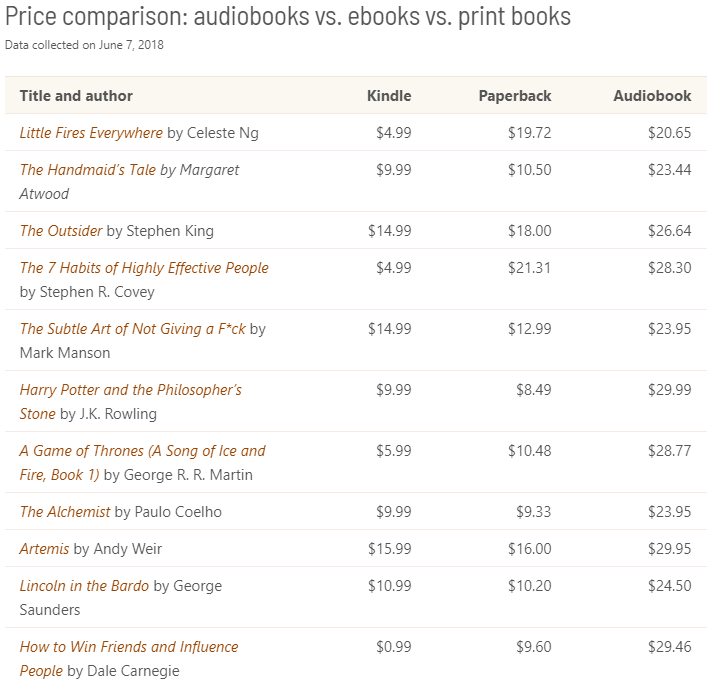
Knowing the time it takes voiceover artists or authors in reading, editing, and creating an audiobook, and the value in having an audiobook to listen to during other activities when reading a physical book is impossible (or dangerous!), it makes sense that some audiobooks are priced accordingly.
I remember how impressed I was hearing a professional voiceover actor read The Count of Monte Cristo via LibriVox. It transformed the reading experience for me and caused me to listen to a few more audiobooks by the same voiceover actor! Thank you, David Clarke!
The Future of Audiobooks
Technology continues to make audiobooks easier to create, distribute, and consume.
Smartphones put entire libraries into our pockets. Streaming services have simplified discovery. Improvements in translation technology, narration tools, and global distribution are making books available to more people than ever before.
At the same time, publishers are increasingly treating audiobooks as a standard format rather than an optional add-on. Readers now expect many new releases to be available in print, ebook, and audio simultaneously.
The future of audiobooks is not about replacing traditional reading. It is about expanding access.
For busy professionals, parents, travelers, and lifelong learners, audiobooks provide another opportunity to engage with stories and ideas during parts of the day that might otherwise go unused.
As accessibility tools improve and more content becomes available worldwide, audiobooks will likely continue playing an important role in how people learn, discover information, and enjoy books.
Print, Ebook, and Audiobook Can Coexist
Some readers prefer physical books.
Others enjoy ebooks for portability.
Many people enjoy audiobooks when reading a physical book isn’t practical.
The growth of audiobooks doesn’t replace traditional reading formats. Instead, it gives readers another way to access information, stories, and ideas.
The strongest publishers increasingly think in terms of multiple formats rather than choosing one over another.
Closing
Audiobooks succeeded because they solved a real problem. They made books accessible during moments when reading a physical page wasn’t possible.
Whether you’re commuting to work, exercising, traveling, or simply looking for a new way to experience books, audiobooks offer another path into learning and storytelling.
The future of publishing is unlikely to belong to a single format. Print books, ebooks, and audiobooks each serve different purposes. Readers benefit when creators embrace all three.
What are your favorite audiobooks? I’d love to hear your recommendations in the comments.

Wilburson
October 5, 2019Such an interesting post Rhys especially delving back into the early history of audiobooks. I had not realised quite how long they have been around. In our multi-tasking time-deprived society I’m sure that the up take of audiobooks is certain to increase and they will finally become the norm. You make a good point about the disability angle too. I know many younger people already embracing learning through audio applications and it is a wise time investment. Then there’s always the entertainment audiobooks which could be shared by a whole family on a car journey. Exciting times ahead in the audiobook market.
Rhys Keller
October 5, 2019Thank you, I couldn’t agree more! Who knows what other gold nuggets lay behind the technology we see as commonplace in our modern world. Audiobooks will certainly grow in influence and quality as more people become connected.
Mylinda Elliott
October 5, 2019I have never quite figured out audio books very easy. The few I have listened to have been great though. Thank you for the back story
Rhys Keller
October 5, 2019Thanks, Mylinda. You’ll get the hang of audiobooks soon enough!